Showing posts with label ftl. Show all posts

Tuesday, September 16, 2008

Juggler of Worlds

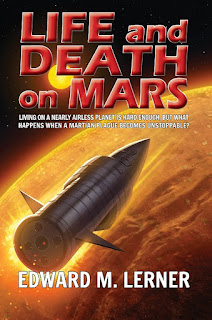
Full disclosure up front: Today's post IS explicitly about my own writing. I have a new book released today, and that's still enough of a novelty (heh!) to be special.

Juggler of Worlds
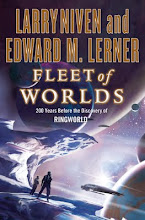
Juggler of Worlds is my second collaboration with NY Times bestseller Larry Niven (the first was Fleet of Worlds). Juggler takes place in Larry's far-ranging Known Space venue – and Juggler's release is what's had me musing in a recent post about faster-than-light travel in SF.

Known Space brims with aliens and interstellar adventure -- with plots briskly advanced by FTL drives. And Juggler itself? It has a brilliant human paranoid with a gift for sniffing out alien plots, plenty of aliens plotting, and heroic aliens, too. If you're a Known Space aficionado (NOT required), Juggler is an opportunity to discover that much of what you believe about Known Space … isn't quite what you thought.

Curious about Known Space? The Incompleat Known Space Concordance is a neat resource.

If you're curious about Juggler of Worlds itself, check out Amazon or see what the publisher has to say.

Sunday, September 14, 2008

Trope-ing the light fantastic (FTL)

Nothing goes faster than light, right? Relativity theory settled that, surely.
Okay, that's orthodoxy. But quantum mechanics is also orthodoxy, and physics has yet to reconcile relativity with QM. So there's something basic we don't understand. (I'll look at string theory, the brave new hope for reconciliation, in another post. It isn't pretty.)
Must SF prove relativity wrong to use FTL as anything other than a trope? In my opinion, no. It's sufficient to rely (implicitly or explicitly) on issues with and ambiguities in accepted theory. To name a couple:
Maybe the speed of light, even if we can't exceed it, isn't a constant. Check out Faster than the Speed of Light by physicist Jaoa Magueijo. Variable light speed does away with the kludge to Big Bang theory that is cosmic inflation. And some of Magueijo's variable-light-speed theories envision faster light speed in the vicinity of cosmic strings. (These aren't the strings of string theory. The terminology is unfortunate.)
And string theory -- despite its lack of concrete success -- is mainstream physics. String theory envisions extra dimensions beyond the 4-D space-time continuum of relativity. Maybe the 4-D universe we experience is afloat in up to (in the predominant theory) 11 dimensions. As long as string theory remains mainstream physics, it's hard to see why science fiction can't use some sort of subspace, hyperspace, or extra-dimensional (see [membrane theory) shortcut with the net effect in this universe of faster-than-light travel.

Friday, September 12, 2008

Trope-ing the light fantastic (Intro)

SF is rife with tropes (say that quickly ten times).

In mainstream lit, a trope is a figure of speech: metaphor, simile, irony, or the like. Words used other than literally. In SF, a trope is more: science used other than literally. I think of an SF trope as a willing-suspension-of-disbelief contract between author and reader.

Tropes. That’s how SF stories get (to name a few) faster-than-light travel, telepathy, and time travel. Author and reader agree -- despite contradiction with prevailing scientific theory and/or the lack of supporting evidence -- to include such an element in a story.

Let’s start with FTL. Clearly many of us want fast interstellar travel in our SF. Consider these media franchises: Star Trek, Star Wars, Stargate, Aliens. In the written form: Brin’s Uplift universe, Niven’s Known Space, and Herbert(s)’s Dune series.

So why FTL? To plot on worlds we might want to colonize. To plot with aliens enough like us (e.g., oxygen breathers) to covet the worlds we will. Astronomy has long eliminated the other worlds of this solar system from consideration.

It wasn’t always so. Once there was Terra Incognita. Homer could confront Odysseus with fabulous creatures somewhere in the Mediterranean. Not that long ago, leading scientists thought Mars was hospitable to life and even saw evidence there of intelligence.

Many SF authors and readers have embraced the trope of FTL travel. Or is it a trope? That is, is FTL a fantasy? That’s the subject of an upcoming post.