 |
| More dark than light |
Showing posts with label physics. Show all posts
Showing posts with label physics. Show all posts
Tuesday, July 16, 2019
Always be skeptical of first reports ...
Carl Sagan had it right: "extraordinary claims require extraordinary evidence."
In that spirit, see: Astronomers Just Solved The Bizarre Mystery of a Galaxy With No Dark Matter


Tuesday, June 11, 2019
Potpourri (an astronomy edition)
Because -- as if you hadn't noticed -- I'm into astronomy. And so, herewith:
The birth of radio astronomy: "Project Diana Honored With an IEEE Milestone."
"Signs of a ‘super Earth’ discovered around a nearby star." How near? Barnard's Star -- after the Alpha Centauri triple system, our closest neighbor. (Not to mention, home to the perfidious Snakes of my InterstellarNet series.)
Also, "A star is born: Astronomers witness rare birth of a baby binary."
And a new place to look for company. "Searching for ET? Look to binary stars, researchers say."
Closer to home, we have: "Asteroid Bennu is flinging rocks into space: OSIRIS-Rex’s target turns out to be very rare, and very active, posing problems for the mission."
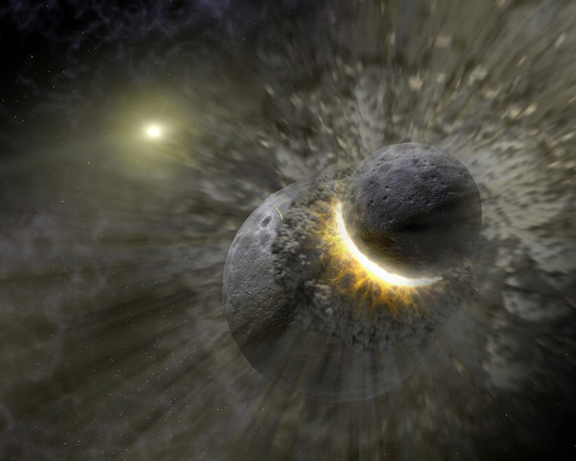
Closer still: "Earth magma ocean ended up on the moon: New modelling resolves contradictions in Earth-moon hypothesis."
And that, surely, is enough to amuse my fellow astronomy fans for the day ....
 |
| The football-field-sized radio telescope so central to my Energized |
"Signs of a ‘super Earth’ discovered around a nearby star." How near? Barnard's Star -- after the Alpha Centauri triple system, our closest neighbor. (Not to mention, home to the perfidious Snakes of my InterstellarNet series.)
Also, "A star is born: Astronomers witness rare birth of a baby binary."
And a new place to look for company. "Searching for ET? Look to binary stars, researchers say."
Closer to home, we have: "Asteroid Bennu is flinging rocks into space: OSIRIS-Rex’s target turns out to be very rare, and very active, posing problems for the mission."
 |
| Theia bites the big one |
And that, surely, is enough to amuse my fellow astronomy fans for the day ....
Monday, April 1, 2019
Starry-eyed
You guessed it: a post replete with astronomy news. (Wherein "news" is a relative term. My file of fascinating articles seems to expand faster than I can comment, and some of today's items first came to my attention toward the end of last year. Bear with me. These are all worth a read.)
Today's emphasis: how much remains to be understood about matters astronomical. And how much we continue to discover!
Case in point: details of how how solar systems -- star(s), planets, and lesser bodies -- form. For example, it always seemed impossible that gas giants (i.e., planets like Jupiter) could originate close to a star -- but jovians *are* seen with close-in orbits. The inference drawn has been that such "hot Jupiters" formed farther out, and that the dynamics of interplanetary gravitational interactions on occasion caused planets to spiral inward. For all we know, that is sometimes the case -- but apparently not always. See "Giant planets around young star raise questions about how planets form."
And recent estimates of the number of potentially habitable exoplanets may be due for a downward revision. Determinations of which exoplanets orbit within habitable zones (basically, the range around their respective stars in which water will remain liquid) depend on estimates of the absolute brightness (energy output) of the parent stars. There are several ways to mis-estimate a star's absolute brightness, and if you get it wrong, your estimate of the habitable zone will be off. Planets you thought orbited in the Goldlilocks zone might instead be too hot or too cold. See "Number of Habitable Exoplanets Found by NASA's Kepler May Not Be So High After All."
Today's emphasis: how much remains to be understood about matters astronomical. And how much we continue to discover!
.jpg) |
| By Jove, that's hot! |
And recent estimates of the number of potentially habitable exoplanets may be due for a downward revision. Determinations of which exoplanets orbit within habitable zones (basically, the range around their respective stars in which water will remain liquid) depend on estimates of the absolute brightness (energy output) of the parent stars. There are several ways to mis-estimate a star's absolute brightness, and if you get it wrong, your estimate of the habitable zone will be off. Planets you thought orbited in the Goldlilocks zone might instead be too hot or too cold. See "Number of Habitable Exoplanets Found by NASA's Kepler May Not Be So High After All."
Tuesday, March 5, 2019
So much physics news. So little time.
If you're new to SF and Nonsense, know that before I became a full-time author my background was in physics and engineering. Physics and physics-enabled tech remain compelling interests, and I continue to follow news of the field(s) -- where news can mean "reported in the past few weeks or months," versus "breaking story this past 24-hour media cycle." News such as:
 Recent years have bombarded us with gloomy predictions of the imminent demise of Moore's Law.(*) True, the shrinkage of transistors has slowed down, because chip makers' focus lately has tended more toward any means of reducing chips' power consumption -- i.e., coping with the aggregated waste heat from literally billions of transistors shoehorned onto a chip -- but transistor densities do continue to rise.
(*) That "law," if it's unfamiliar, basically forecasts a steady rate of shrinkage of transistor dimensions -- thereby increasing the number of transistors on a single chip -- with attendant increases in transistor speed and improved power thriftiness. When Gordon Moore first made his prediction, chips held, at most, a few dozen transistors each with multi-micrometer features. Many chips today hold billions of transistors, with features measuring but 14 nanometers.
Increasingly, a third dimension plays an interesting role in chip design. Several manufacturers have taken to stacking transistor layers to increase overall density. Now, in a new twist, and for reasons unrelated to transistor density, others may go toward all but eliminating circuit depth. As in, getting to a news item: "2D diamonds set to drive radical changes in electronics."
(*) That "law," if it's unfamiliar, basically forecasts a steady rate of shrinkage of transistor dimensions -- thereby increasing the number of transistors on a single chip -- with attendant increases in transistor speed and improved power thriftiness. When Gordon Moore first made his prediction, chips held, at most, a few dozen transistors each with multi-micrometer features. Many chips today hold billions of transistors, with features measuring but 14 nanometers.
Increasingly, a third dimension plays an interesting role in chip design. Several manufacturers have taken to stacking transistor layers to increase overall density. Now, in a new twist, and for reasons unrelated to transistor density, others may go toward all but eliminating circuit depth. As in, getting to a news item: "2D diamonds set to drive radical changes in electronics."
Thursday, January 3, 2019
A week to restore one's faith in humanity
Clearly, I refer to nothing in the political sphere. But think of the milestones (kilometer stones?) science and technology reached this week. From closest to farthest, we've got:
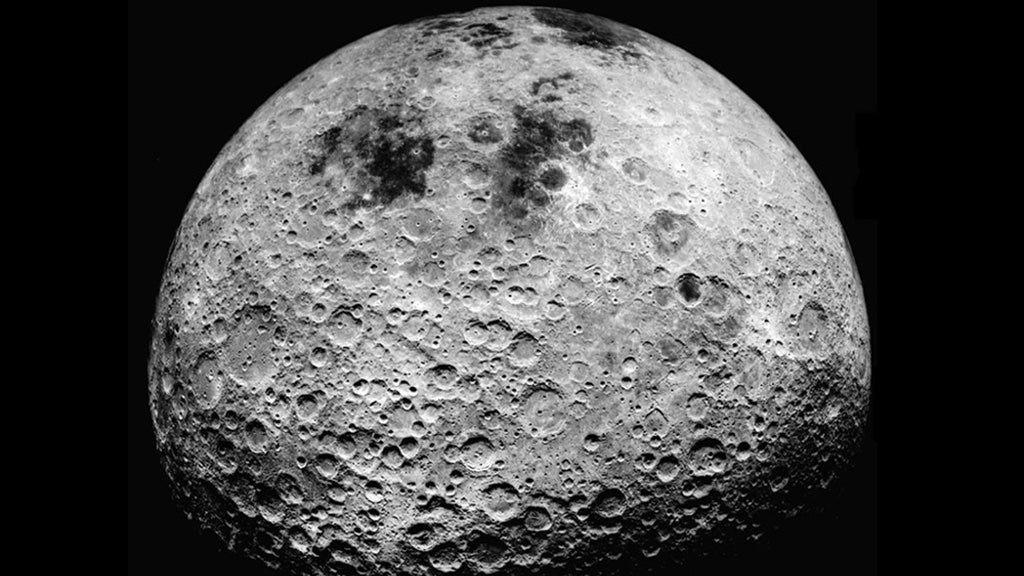
"China’s Chang’e-4 spacecraft makes historic landing on far side of the Moon."
The Chinese spacecraft Chang’e-4 has landed on the far side of the Moon
and has begun relaying data and images back to Earth. It is the first
mission to operate on the far side, which is the hemisphere of the Moon
that always faces away from Earth. This half of the Moon has a much
more rugged and varied landscape than the hemisphere that is visible
from Earth and studying its geology could provide important information
about how the Moon and the rest of the solar system formed.
Also, NASA's "OSIRIS-REx probe goes into close orbit around asteroid Bennu and sets a record."
NASA’s OSIRIS-REx spacecraft today maneuvered into an orbit that
takes it within 4,000 feet of the surface of Bennu, a diamond-shaped
asteroid that’s 70 million miles from Earth.
The orbit sets a record for interplanetary travel. The quarter-mile-wide asteroid is now the smallest body ever orbited by a spacecraft, and the spacecraft is tracing the closest sustained orbit around a celestial body.
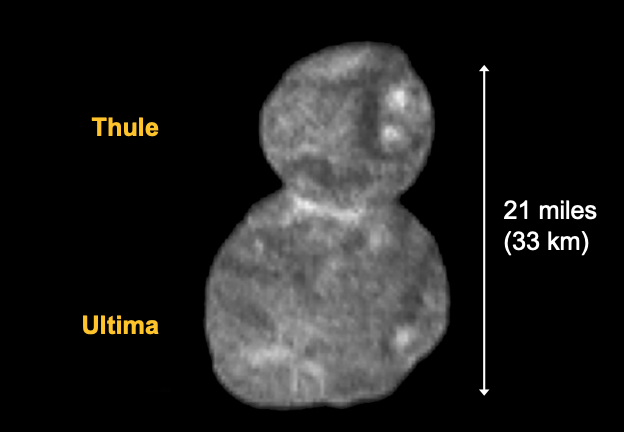
And (IMO, the most awesome of all) in the distant Kuiper Belt, Nasa's New Horizons: 'Snowman' shape of distant Ultima Thule revealed."
"[Ultima's] only really the size of something like Washington DC, and
it's about as reflective as garden variety dirt, and it's illuminated by
a Sun that's 1,900 times fainter than it is outside on a sunny day here
on the Earth. We were basically chasing it down in the dark at
32,000mph (51,000km/h) and all that had to happen just right," the SwRI
scientist said.
We Homo saps actual can accomplish great things when we cooperate and focus.
"China’s Chang’e-4 spacecraft makes historic landing on far side of the Moon."
 |
| The lunar far side |
Also, NASA's "OSIRIS-REx probe goes into close orbit around asteroid Bennu and sets a record."
 |
| Artist rendering |
The orbit sets a record for interplanetary travel. The quarter-mile-wide asteroid is now the smallest body ever orbited by a spacecraft, and the spacecraft is tracing the closest sustained orbit around a celestial body.
And (IMO, the most awesome of all) in the distant Kuiper Belt, Nasa's New Horizons: 'Snowman' shape of distant Ultima Thule revealed."
 |
| 4 billion miles away |
We Homo saps actual can accomplish great things when we cooperate and focus.
Monday, November 5, 2018
Physics cornucopia (physicopia?)
You know my eclectic file of intriguing news from the world of physics, into which I dip from time to time? Well, that file (metaphorically speaking, anyway) is bulging. Which gives us this week's topic.
You know all those tidy equations we learn in physics classes? They often deal with idealized situations, like friction-less planes. The real world tends to the chaotic.(*)
(*) To physicists and mathematicians, "chaos" has a precise meaning: dynamic, generally nonlinear, systems that are extremely sensitive to initial conditions.
Or does it? See "Is nature really chaotic and fractal, or did we just imagine it?" A key quote:
The way we perceive reality is a function of how we slice and dice the physical world.

Tuesday, September 25, 2018
Of the universe
Today's post is a roundup of recent astronomy news.
First, and closest to home, a look at a neighbor: "Ice Confirmed at the Moon's Poles." Such ice has long been suspected, of course, and indirect evidence of it gleaned -- but this is the most definitive proof yet. Water on the Moon is seriously important to any hopes for a permanent lunar presence.
If I may then look ahead to upcoming discoveries, consider "NASA’s Lucy in the sky with Trojans." "Lucy" in this context is a probe to be launched in 2021 to explore (mainly) Jupiter's Trojan asteroids. These asteroids co-orbit with Jupiter, one bunch 60 degrees ahead of the planet, the other 60 degrees behind. (They're called "Trojan" because the first few of these rocks were named for heroes of the mythic war.) And they're darned varied and interesting ...
First, and closest to home, a look at a neighbor: "Ice Confirmed at the Moon's Poles." Such ice has long been suspected, of course, and indirect evidence of it gleaned -- but this is the most definitive proof yet. Water on the Moon is seriously important to any hopes for a permanent lunar presence.
 |
| Lucy (in a few years) |
Tuesday, August 14, 2018
What's up, Doc?
Astronomical news, of course :-)
Neutrinos are amazing particles. They interact so weakly with more familiar matter that it took decades to decide a neutrino had any mass at all. Aim a beam of neutrinos at a light-year thickness of lead, and half the neutrinos will emerge out the far side.
Our neighborhood neutrino factory -- aka, the Sun -- spits out a torrent of these particles. "Theoretical calculations say that about 65 billion neutrinos pass through every square centimeter region of the Earth's surface every second." (*) So how amazing is it that one neutrino recently made big news?
(*) "Nobel neutrinos"
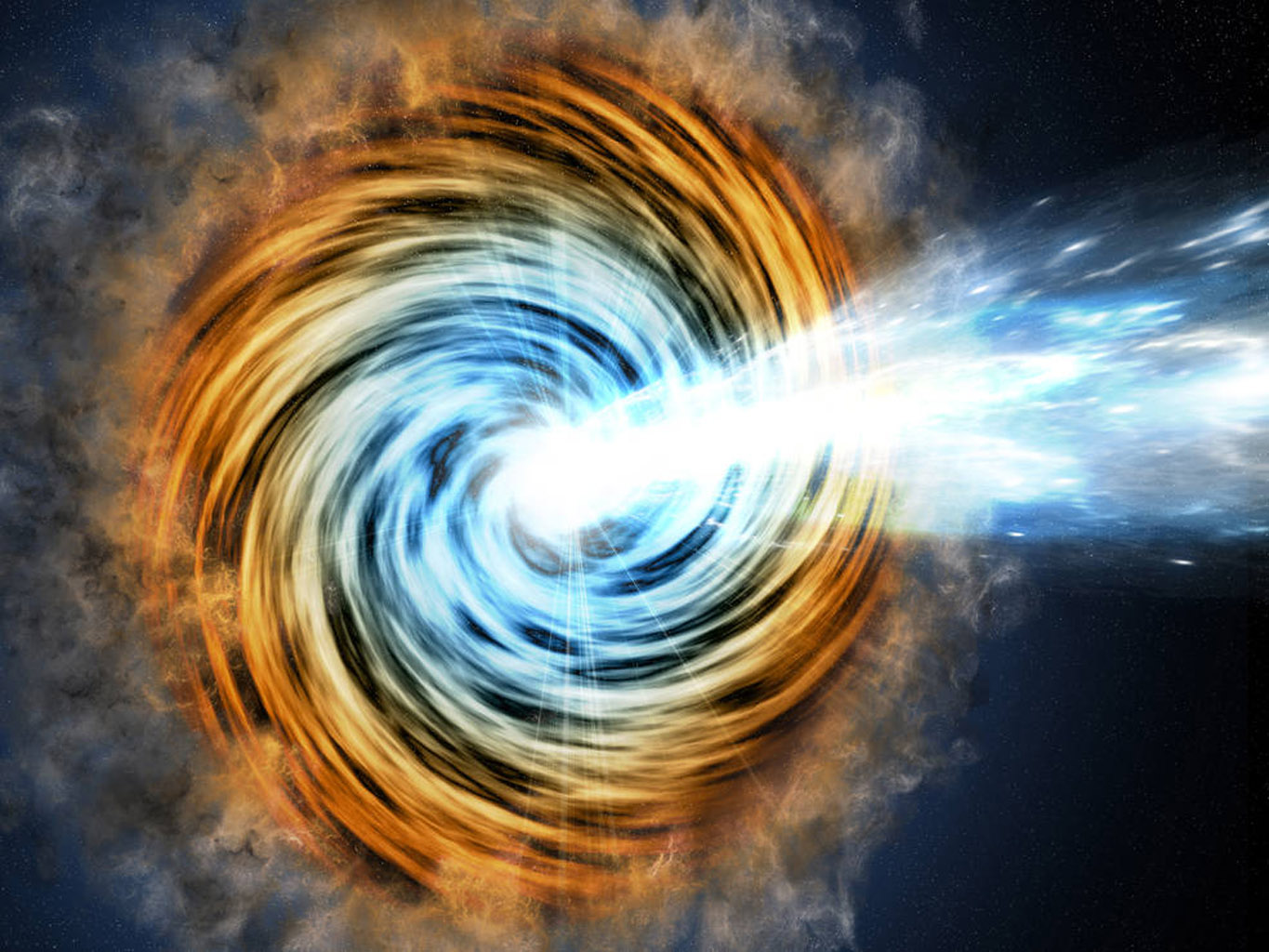
IMO, pretty amazing. Because this
extremely high-energy neutrino was correlated to a particular event: a
blazar -- aka, an active galactic nucleus -- about four billion
light-years (and years) distant.
This correlation marks the first step toward a third type of observation in the nascent science of multi-modal astronomy. That is, in addition to traditional observations (using, from longest to shortest wavelengths: radio waves, microwaves, infrared, visible light, ultraviolet, X-ray, and/or gamma-ray electromagnetic radiation) and -- for a very few years now -- gravitational-wave observations, we can now foresee combining neutrino observations. In a word: awesome.
For more on this particularly fascinating neutrino detection, see "Why a 4-Billion-Year-Old Particle That Hit Antarctica Is Such a Big Deal."
Neutrinos are amazing particles. They interact so weakly with more familiar matter that it took decades to decide a neutrino had any mass at all. Aim a beam of neutrinos at a light-year thickness of lead, and half the neutrinos will emerge out the far side.
Our neighborhood neutrino factory -- aka, the Sun -- spits out a torrent of these particles. "Theoretical calculations say that about 65 billion neutrinos pass through every square centimeter region of the Earth's surface every second." (*) So how amazing is it that one neutrino recently made big news?
(*) "Nobel neutrinos"
 |
| Blazar saddles? |
This correlation marks the first step toward a third type of observation in the nascent science of multi-modal astronomy. That is, in addition to traditional observations (using, from longest to shortest wavelengths: radio waves, microwaves, infrared, visible light, ultraviolet, X-ray, and/or gamma-ray electromagnetic radiation) and -- for a very few years now -- gravitational-wave observations, we can now foresee combining neutrino observations. In a word: awesome.
For more on this particularly fascinating neutrino detection, see "Why a 4-Billion-Year-Old Particle That Hit Antarctica Is Such a Big Deal."
Monday, July 9, 2018
Life, the universe, and everything ...
And yet, the number 42 isn't involved :-)
Great observatories have (ahem) greatly extended our understanding of the universe. So, first, let us mark an imminent sad passing: "NASA put its famous planet-hunting telescope to sleep because it’s almost out of fuel: The Kepler Space Telescope’s life is finally coming to an end." This fine astronomical instrument detected more than 2K subsequently confirmed exoplanets (with more confirmations likely yet to come). Quite the legacy.
Another fine instrument -- this one Earthbound: the European Southern Observatory’s Very Large Telescope -- has, for the first time, caught a planet in the very first stages of formation. See: "First confirmed view of a newborn planet: A planet coalesces from the disc of dust and gas around the dwarf star PDS 70."
Alas, the it's-been-coming-forever James Webb Space Telescope -- NASA's long-heralded successor mission to the (fortunately still hanging in there) Hubble Space Telescope -- has hit another snag. As in, "NASA Delays Launch of James Webb Space Telescope Again — This Time to 2021."
That's one day's view of (viewing) the universe. As for the life part of the subject line, an over-hyped bit of last week's science news. First, an example of the more breathless reporting: "Large molecules show Enceladus 'clearly is habitable for life' " And here is a more cautiously (IMO, more precisely) worded version: "No, NASA Did Not Find Even 'Hints Of Life' On Enceladus."
And everything? That was everything for today ;-)
 |
| The not-so-little observatory that could |
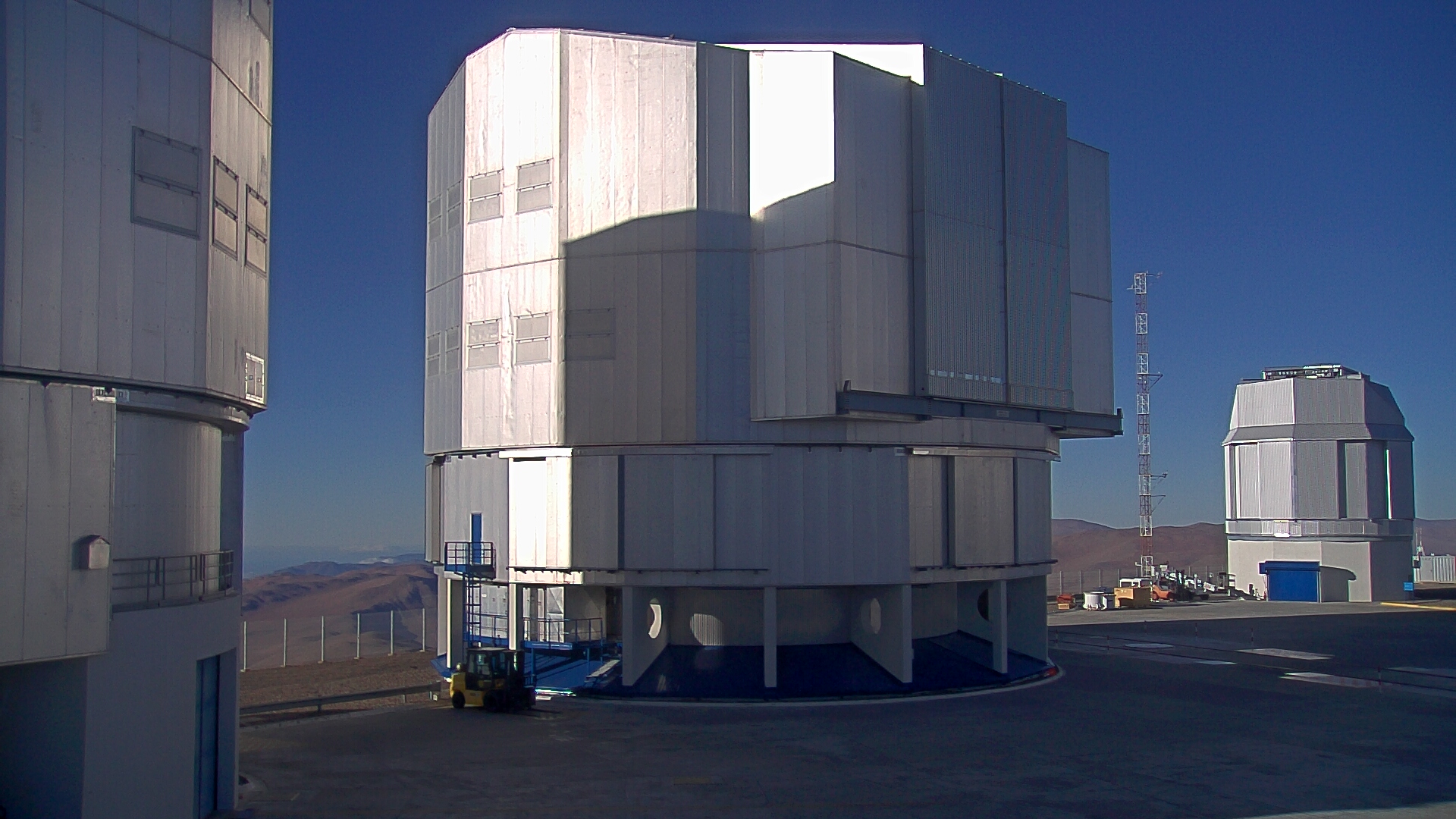 |
| The ESO VLT |
 |
| The JWST. Much assembly required. |
That's one day's view of (viewing) the universe. As for the life part of the subject line, an over-hyped bit of last week's science news. First, an example of the more breathless reporting: "Large molecules show Enceladus 'clearly is habitable for life' " And here is a more cautiously (IMO, more precisely) worded version: "No, NASA Did Not Find Even 'Hints Of Life' On Enceladus."
And everything? That was everything for today ;-)
Monday, June 18, 2018
Starstruck
Today's post is astronomy-related.
Arguably challenging my subject line -- but "planet" did, originally, mean "wandering star" -- the first of two subtopics herein could be described as planet-struck. The generally accepted theory of solar-system formation involves a great deal of accretion and sweeping up of matter from the ancestral "solar nebula." If I may quote myself: (*)
So. The first of today's spectacular astronomy reports involves the opening of a metaphorical window into that violent process, that ancient era, in the form of apparent fragments discovered of a long-vanished protoplanet. More specifically, asteroid remains have been recovered that:
Arguably challenging my subject line -- but "planet" did, originally, mean "wandering star" -- the first of two subtopics herein could be described as planet-struck. The generally accepted theory of solar-system formation involves a great deal of accretion and sweeping up of matter from the ancestral "solar nebula." If I may quote myself: (*)
"Aggregating, clumping, sweeping … it all sounds stately and serene. It can happen that way—but usually doesn’t. The heavily cratered surface of the Moon testifies to the violence of the Solar System’s (not thought to be unusual) Late Heavy Bombardment period. The Moon itself, it is believed, coalesced from Earth-orbiting debris after a Mars-sized protoplanet struck the young Earth a glancing blow."
(*) from Trope-ing the Light Fantastic: The Science Behind the Fiction
 |
| The Moon is born? |
"... could only have formed under incredible pressure — the equivalent of diving 600 kilometers into Earth's interior or attempting to hold up 100,000 tons with your bare hands...
...
"... the meteorite's parent body would have to have been a planet at least as big as Mercury and possibly as large as Mars."For the full story, see, "These diamonds from space formed inside a long-lost planet, scientists say."
Tuesday, April 17, 2018
Look! Up in the sky! ...
It's astronomy news!
And surely real news of astronomy beats an imaginary guy in tights and a cape.
Case 1: the mind-blowingly mobile mountains of Pluto. (Say that quickly ten times.) See "Pluto’s mountains may have slid along a kilometre a day." That rate of motion isn't something you'd expect to see of a glacier on Earth, much less of ice mountains in the outer Solar System deep freeze. But facts are stubborn things ...
And surely real news of astronomy beats an imaginary guy in tights and a cape.
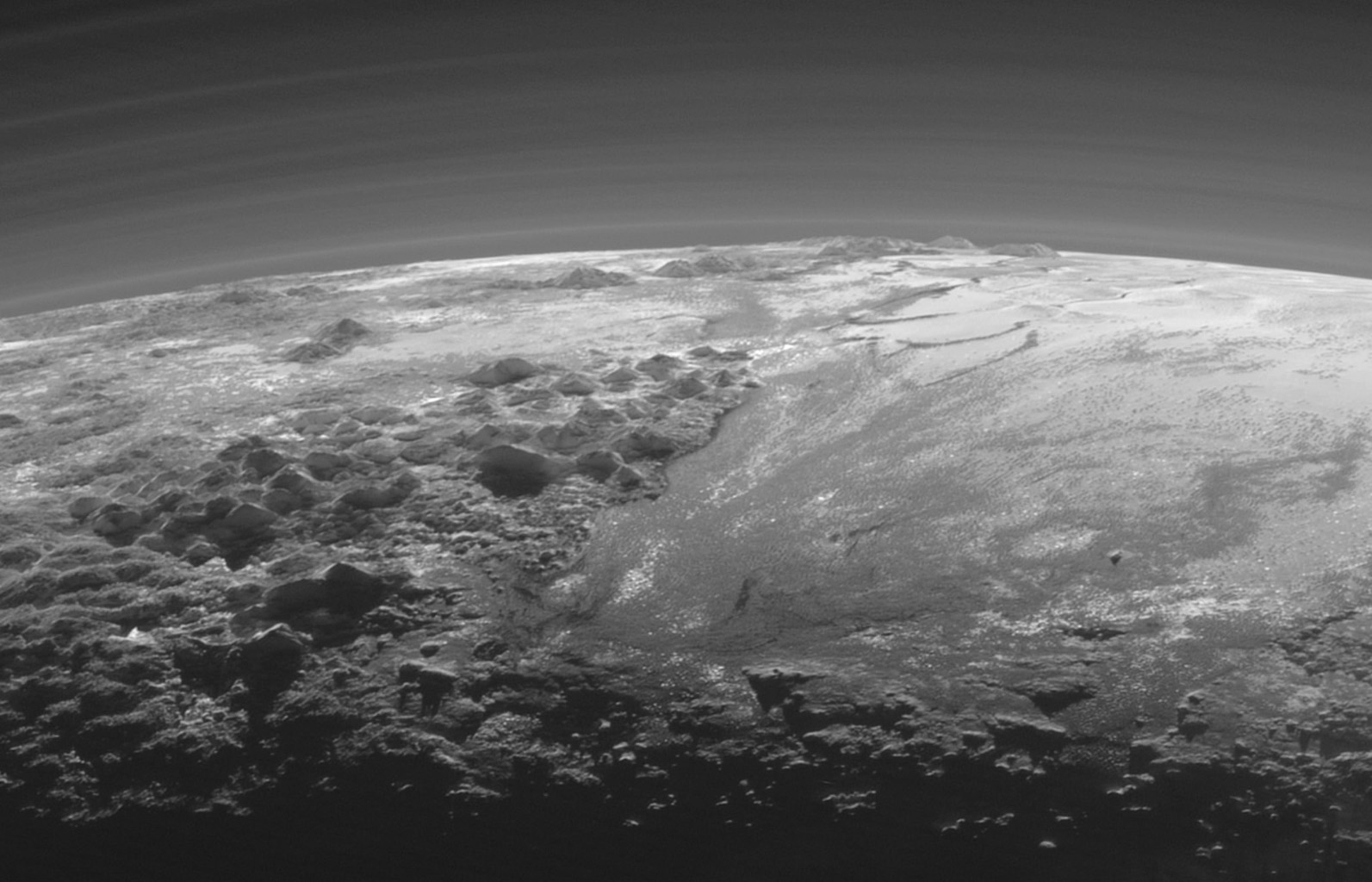 |
| The Mountains of Madness (er, Pluto) |
Monday, March 26, 2018
Looking back
For today's post, some physics (including astrophysics) retrospectives ....
My first interest in any kind of science -- likely before I knew the word science -- was with astronomy. Who among us wasn't fascinated at a young age with the fascinating show that is the night sky? And so (with added interest because of the University of Chicago connection), I was sad to read that "Yerkes Observatory is closing its doors." Yerkes is historic both for the uniqueness of its primary instrument -- a 40-inch refracting telescope -- and the many prominent astronomers who at one time or another worked there. Edwin Hubble. Subrahmanyan Chandrasekhar. Gerard Kuiper. Carl Sagan.
Looking a lot further back, consider an inference drawn from orbital peculiarities of a set of Oort Cloud objects. To wit: "An alien star sideswiped our solar system and sent comets reeling, scientists say."
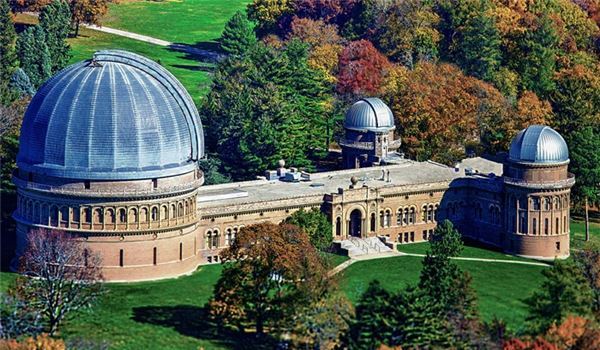 |
| And ... it's beautiful |
Looking a lot further back, consider an inference drawn from orbital peculiarities of a set of Oort Cloud objects. To wit: "An alien star sideswiped our solar system and sent comets reeling, scientists say."
Monday, March 19, 2018
Of space ... and spaciness
Updated March 24, 2018 (at the end of this post)
The Moon remains the the high-water mark of in-person human exploration. (That may someday change -- thank you, Elon Musk -- but for now, it is what it is.)
One of the things I find most fascinating about that too-long-since-visited neighbor is how little we know about it. The debate continues about how the Moon first came to be. While I find the prevailing Theia/Giant-Impact Hypothesis qualitatively plausible -- it's not like I've done the math -- that theory has its share of loose ends and doubters. So I was fascinated to read this recent speculation: "Freaky Theory Offers Totally New Explanation of the Moon’s Origin." (Perhaps it has something to do with my love of doughnuts. Really.)
The Moon remains the the high-water mark of in-person human exploration. (That may someday change -- thank you, Elon Musk -- but for now, it is what it is.)
 |
| Mmmm. Dough ... nut. |
Tuesday, January 23, 2018
Space-y matters
And my fascination with matters astronomical continues. If you share my interest, you will want to read on.
To date, not a single experiment has shed any light (bon mot intended) on the nature of dark matter or dark energy. The former is invoked to explain certain otherwise inexplicable, and presumably gravitationally caused, behaviors (e.g., the orbital periods of stars in galaxies, and galaxies within clusters). The latter is invoked to explain the otherwise inexplicable increasing-with-time rate of the Universe's overall expansion. The rate of expansion is inferred from the observed red shifts of distant, hence seen in their distant pasts, "standard candle" supernovae.
This lack of success in understanding dark matter and/or dark energy is what makes the following -- very sketchy, so far -- article so provocative: "Radical dark matter theory prompts robust rebuttals: The idea that dark energy and dark matter aren’t needed to explain the properties of the universe is meeting fierce opposition." Stay tuned.
And speaking of galaxies, what begins and ends their formation of stars? Again, there are lots of theories. Evidence? That's another matter. So I was delighted to read this: "We Just Got The First Direct Evidence That Supermassive Black Holes Control Star Formation." (How massive is super massive? Oh, about a million times the mass of the Sun.)
Among astrophysicists, a popular exercise is explaining, as best they can, the relative abundances and distributions of various elements and isotopes. (You don't wonder about the abundance of aluminum-26 in the early Solar System? What's wrong with you?) And why is that? Because it is believed the explanation(s) is to be found in a deep understanding of the mechanisms of the early Universe and, since then, such violent stellar processes as supernovae. (Useful buggers, those supernovae. As long as they don't happen in your neighborhood.)
Where the above/dark-whatever item speculated about possible changes in cosmic attributes over time, this item deals with a non-homogeneity in space. To wit: "Our solar system may have formed inside a giant space bubble: This new theory explains the proportions of certain elements in the early solar system."
Experience teaches that any explanation at odds with the Copernican principle merits skepticism. Still, nothing in astronomy precludes local anomalies. In this case, the local "quirk" would be our Solar System having formed from, and within, the exploded remains of a onetime Wolf-Rayet star (like the image immediately above). Bottom line: there's nothing definitive in this speculation, either ... just an intriguing idea.
 |
| Whistling in the dark (matter)? |
This lack of success in understanding dark matter and/or dark energy is what makes the following -- very sketchy, so far -- article so provocative: "Radical dark matter theory prompts robust rebuttals: The idea that dark energy and dark matter aren’t needed to explain the properties of the universe is meeting fierce opposition." Stay tuned.
And speaking of galaxies, what begins and ends their formation of stars? Again, there are lots of theories. Evidence? That's another matter. So I was delighted to read this: "We Just Got The First Direct Evidence That Supermassive Black Holes Control Star Formation." (How massive is super massive? Oh, about a million times the mass of the Sun.)
Among astrophysicists, a popular exercise is explaining, as best they can, the relative abundances and distributions of various elements and isotopes. (You don't wonder about the abundance of aluminum-26 in the early Solar System? What's wrong with you?) And why is that? Because it is believed the explanation(s) is to be found in a deep understanding of the mechanisms of the early Universe and, since then, such violent stellar processes as supernovae. (Useful buggers, those supernovae. As long as they don't happen in your neighborhood.)
 |
| In our Sun's beginning? (Image by ESA/Hubble) |
Where the above/dark-whatever item speculated about possible changes in cosmic attributes over time, this item deals with a non-homogeneity in space. To wit: "Our solar system may have formed inside a giant space bubble: This new theory explains the proportions of certain elements in the early solar system."
Experience teaches that any explanation at odds with the Copernican principle merits skepticism. Still, nothing in astronomy precludes local anomalies. In this case, the local "quirk" would be our Solar System having formed from, and within, the exploded remains of a onetime Wolf-Rayet star (like the image immediately above). Bottom line: there's nothing definitive in this speculation, either ... just an intriguing idea.
Tuesday, November 28, 2017
Shopped out yet? Then thank your lucky stars for *this*
Okay, not stars exactly, lucky or otherwise. But nonetheless astronomy news to take your mind off the post-Thanksgiving rat race ....
(Wait. What? You say you're not yet shopped out? Then see "Buy-a-Book Saturday redux." No need to be too literal here.)
Let's start with "An interstellar rock gets a name." The very first known interstellar interloper will henceforth be known -- never mind that it will soon have receded forever beyond our sight -- as Oumuamua. ("This is a Hawaiian name, meaning, roughly, 'very first scout.' ") Or, more formally, as 1I/2017 U1.
We've even gained an inkling about the appearance of Oumuamua. See "ESO Observations Show First Interstellar Asteroid is Like Nothing Seen Before: VLT reveals dark, reddish and highly-elongated object." (ESO is the European Southern Observatory. VLT is ESO's Very Large Telescope.)
You've likely encountered reports that surface flows of water have been detected on Mars. Not so fast. Once geologists from the US Geological Survey reviewed the satellite observations, they reached a different conclusion: that "The case for flowing water on Mars is drying up." More specifically, the geologists interpreted:
... the “streaks” didn't behave like flowing water. For one thing, they existed only at the tops of very steep slopes. For another, the streaks all seemed to end when their slopes matched the dynamic “angle of repose” — the steepest angle at which a given material can be piled without slumping.
If you've ever tried to build a sand castle, you're familiar with this concept. It's why dry sand -- which has a very shallow angle of repose -- tends to slide out of shape, but wet sand -- with a steeper angle of repose -- can be piled into towers and turrets.
(Wait. What? You say you're not yet shopped out? Then see "Buy-a-Book Saturday redux." No need to be too literal here.)
Let's start with "An interstellar rock gets a name." The very first known interstellar interloper will henceforth be known -- never mind that it will soon have receded forever beyond our sight -- as Oumuamua. ("This is a Hawaiian name, meaning, roughly, 'very first scout.' ") Or, more formally, as 1I/2017 U1.
 |
| Oumuamua (an artists' conception) |
We've even gained an inkling about the appearance of Oumuamua. See "ESO Observations Show First Interstellar Asteroid is Like Nothing Seen Before: VLT reveals dark, reddish and highly-elongated object." (ESO is the European Southern Observatory. VLT is ESO's Very Large Telescope.)
You've likely encountered reports that surface flows of water have been detected on Mars. Not so fast. Once geologists from the US Geological Survey reviewed the satellite observations, they reached a different conclusion: that "The case for flowing water on Mars is drying up." More specifically, the geologists interpreted:
... the “streaks” didn't behave like flowing water. For one thing, they existed only at the tops of very steep slopes. For another, the streaks all seemed to end when their slopes matched the dynamic “angle of repose” — the steepest angle at which a given material can be piled without slumping.
If you've ever tried to build a sand castle, you're familiar with this concept. It's why dry sand -- which has a very shallow angle of repose -- tends to slide out of shape, but wet sand -- with a steeper angle of repose -- can be piled into towers and turrets.
Tuesday, October 31, 2017
When the Moon hits your eye ...
It may or may not be amore, but I do quite enjoy astronomy. (Dean Martin? Not so much.) So, in today's post, we'll consider a few recent and exciting bits of astronomical analysis and discovery.
A dominant feature of modern geological thought is plate tectonics. Tectonics is (in part) a mechanism for recycling Earth's carbon, which would otherwise have long ago become tied up in, for example, limestone and carbonaceous ocean sediments. A strong case can be made that without tectonics none of us, or even much more basic carbon-based life, would exist on this planet. But there's scant evidence that other worlds have tectonics, or any sense of what brought about the formation of Earth's crustal plates.
Which makes this astronomical tie-in -- still only a speculation, to be sure -- fascinating: "Did meteorites create the Earth’s tectonic plates? Modelling suggests that plate
tectonics and the Earth’s magnetic field were the result of massive
collisions during the 'geologic dark age.'"
A dominant feature of modern geological thought is plate tectonics. Tectonics is (in part) a mechanism for recycling Earth's carbon, which would otherwise have long ago become tied up in, for example, limestone and carbonaceous ocean sediments. A strong case can be made that without tectonics none of us, or even much more basic carbon-based life, would exist on this planet. But there's scant evidence that other worlds have tectonics, or any sense of what brought about the formation of Earth's crustal plates.
 |
| Plate tectonics |
Tuesday, October 10, 2017
Wave like a nice black hole ...
I have posted enthusiastically several times about gravitational-wave detections by LIGO (that's the Laser Interferometer Gravitational-Wave Observatory) beginning with Leggo my LIGO, in February 2016. Gravitational waves being very weak, only cataclysmic events -- such as the collision of two black holes -- are (so far, anyway) detectable by the gravitational waves they emit. Of course black holes colliding are very cool events to be able to detect.
In breaking news, the Nobel Committee also thought this was pretty keen: "Three Americans win Nobel Prize in physics for gravitational wave discovery."
Rainer Weiss, Barry C. Barish and Kip S. Thorne have won the 2017 Nobel Prize in physics. The three Americans are members of the LIGO-Virgo detector collaboration that discovered gravitational waves. The prize was awarded “for decisive contributions to the LIGO detector and the observation of gravitational waves,” the committee said in a news release.
LIGO consists of two detectors, placed half a continent apart. To have just one won't do, because it's necessary to distinguish between the tiny jiggle of passing gravitational waves and, say, the rumble of nearby thunderclaps or passing trucks. As a bonus, when both instruments detect a signal, the slight difference in arrival times (the waves traveling at light speed) gives a rough sense for the direction from which the signal originated.
Emphasis on rough.
And another current event, from Sky and Telescope: "Fourth Gravitational Wave Event Detected." What makes this latest detection different from the original three is that, together with LIGO, the Advanced Virgo detector of the European Gravitational Observatory also recorded the event. It's the first for Virgo. And also, a Big Deal. From the S&T article:
With just the two LIGO detections, the uncertainty area measured some 1,160 square degrees on the sky," says Shoemaker. "By adding the Virgo data, this could be brought down to just 60 square degrees."
Mind you, 60 square degrees still covers a lot of sky -- the full Moon covers about a quarter of one square degree. But a reduction from 1160 down to 60 remains a huge improvement. Optical telescopes have not yet seen anything unusual in the target area, but ... maybe next time.
In breaking news, the Nobel Committee also thought this was pretty keen: "Three Americans win Nobel Prize in physics for gravitational wave discovery."
Rainer Weiss, Barry C. Barish and Kip S. Thorne have won the 2017 Nobel Prize in physics. The three Americans are members of the LIGO-Virgo detector collaboration that discovered gravitational waves. The prize was awarded “for decisive contributions to the LIGO detector and the observation of gravitational waves,” the committee said in a news release.
| That's one LIGO instrument |
Emphasis on rough.
And another current event, from Sky and Telescope: "Fourth Gravitational Wave Event Detected." What makes this latest detection different from the original three is that, together with LIGO, the Advanced Virgo detector of the European Gravitational Observatory also recorded the event. It's the first for Virgo. And also, a Big Deal. From the S&T article:
With just the two LIGO detections, the uncertainty area measured some 1,160 square degrees on the sky," says Shoemaker. "By adding the Virgo data, this could be brought down to just 60 square degrees."
Mind you, 60 square degrees still covers a lot of sky -- the full Moon covers about a quarter of one square degree. But a reduction from 1160 down to 60 remains a huge improvement. Optical telescopes have not yet seen anything unusual in the target area, but ... maybe next time.
Monday, September 25, 2017
Astronomy, old and new
We're accustomed to news of exciting celestial discoveries made by American (meaning here: of the USA -- a useful clarification because of other topics to come) observatories and astronomers. It turns out, and I was surprised to read this, that American interest in astronomy goes way back.
 |
| JQ Adams: astronomy geek |
The Atlantic had a recent fascinating piece about that history. To wit -- archaic wording chosen with malice aforethought ;-) -- "The Surprising Space Ambitions in Colonial America: Long before NASA,
private individuals and communities banded together for the pursuit of
geopolitical power and scientific discovery." The article starts in colonial times, but doesn't stop there. Who knew, for example, that John Quincy Adams was an advocate for astronomy? Good stuff.
Speaking of NASA, they recently went far afield to study the Kuiper Belt Object next up on the itinerary for the amazing New Horizons probe. And the journey was worth it. The agency reports: "NASA’s New Horizons Team Strikes Gold in Argentina." The (metaphorical) gold? That the KBO toward which New Horizons is hurtling seems, in fact, to be two objects, in tight orbit around their common center of mass.
Tuesday, September 5, 2017
Water, water everywhere (but beware which sort you drink)
One of my longtime favorite novels is Kurt Vonnegut's Cat's Cradle, in which a major plot element is "ice nine." This is a form of H2O, not naturally occurring in nature, that's crystalline at room temperature. A seed crystal of ice nine turns all regular water in which it is in contact to more ice nine. Bear in mind that we are about 90 percent water. Quite the unique doomsday device ...
Today's post isn't a book review (although I highly recommend Cat's Cradle; we're talking about one of Vonnegut's best). The book came to mind because of what is our topic: the recent real-world discoveries of new forms of H2O).
On the liquid side: "Physicists Discover Two Low-Temperature Forms of Liquid Water: A Stockholm University-led team of physicists has discovered two low-temperature phases of liquid water with large differences in structure and density." Sort of the opposite of ice nine, which is solid at an unexpectedly high temperature.
The takeaway:
"When we think of ice it is most often as an ordered, crystalline phase that you get out of the ice box, but the most common form of ice is amorphous, that is disordered, and there are two forms of amorphous ice with low and high density. The two forms can interconvert and there have been speculations that they can be related to low- and high-density forms of liquid water.
“We found that water can exist as two different liquids at low
temperatures (minus 234 degrees Fahrenheit, or minus 148 degrees
Celsius) where ice crystallization is slow,” said Anders Nilsson,
professor in chemical physics at Stockholm University, and senior author
of the paper reporting the results in the Proceedings of the National Academy of Science."
And on the solid side, we have "To make hot ice, take one diamond and vaporise with a laser: Creating an exotic state of water that may exist on other planets is a high-pressure job." ("Vaporise" is not a typo... this article is from Cosmos, an Aussie zine.) The takeaway here:
.jpg) |
| Highly recommended |
On the liquid side: "Physicists Discover Two Low-Temperature Forms of Liquid Water: A Stockholm University-led team of physicists has discovered two low-temperature phases of liquid water with large differences in structure and density." Sort of the opposite of ice nine, which is solid at an unexpectedly high temperature.
The takeaway:
"When we think of ice it is most often as an ordered, crystalline phase that you get out of the ice box, but the most common form of ice is amorphous, that is disordered, and there are two forms of amorphous ice with low and high density. The two forms can interconvert and there have been speculations that they can be related to low- and high-density forms of liquid water.
 |
| Not ice nine (fortunately) |
And on the solid side, we have "To make hot ice, take one diamond and vaporise with a laser: Creating an exotic state of water that may exist on other planets is a high-pressure job." ("Vaporise" is not a typo... this article is from Cosmos, an Aussie zine.) The takeaway here:
Tuesday, August 29, 2017
Look! Up in the sky! Dark awesomeness.
My most recent post having been about the awesomeness of last week's total solar eclipse, why not post more generally about astronomy/cosmology news? Exciting things are happening in the broader (heh!) field -- as these four recent articles from Cosmos attest.
What we (think we) understand about the distribution of dark matter is inferred from observations of the motions of stars. A small fraction of stars move much faster than expected. So: what's that about? It's hard to know when so few stars are anomalous speed demons. If we had a bigger population to analyze, maybe we'd understand better. And -- leveraging a quite non-astronomical discipline -- perhaps soon we will. See "Artificial brain scans the galaxy for speeding stars: Neural networks come to astronomy as a self-adapting algorithm digs through star maps to find rogue fast-moving stars."
 |
| Pink: most normal/visible mass. Blue: where most mass seems to be. |
Subscribe to:
Posts (Atom)









 Posts
Posts


