Showing posts with label sociology. Show all posts

Tuesday, April 8, 2014

Wild and crazy (not always in a good way) stuff

It will surprise no one who often stops by this blog that I follow science news -- but that doesn't mean I get excited about every supposed finding. Perhaps that's because some reported results are made up. See, from Scientific American, "Publishers Withdraw More than 120 Gibberish Science and Engineering Papers." Because said papers were shown to be computer-generated nonsense!

Bigger than worlds
It should likewise be no surprise that I follow reports about hacking -- but this headline (from the IEEE) blew me away: "Hacking the Van Allen Belts: Could we save satellites and astronauts by wiping out the Van Allen belts?" I'd be loath to tinker with a system as little understood as interactions between Earth and its nearby space, but the possibility is fascinating. And I can see the case for restoring the Belts to their natural state before above-ground nuclear testing.

Because there are a lot of satellites. Don't take my word for it when you can see "Every single satellite orbiting Earth, in a single image."

Tuesday, February 11, 2014

Arcana and sundry

Fans of science -- and fans of SF, who significantly overlap with the aforementioned group -- are a curious bunch. Whatever our primary area(s) of study, both find enjoy a broad range of other interests. Hence ...

Internet years vs. dog years
An Internet year is pretty much the inverse of a dog year. And so, lots of companies that not long ago bestrode the Internet like giants are, well ... reduced to wee status. From PC World, see "From Netscape to Napster: Whatever happened to yesterday's giants?"

Did you ever try one of those clunky, expensive, 3-D TVs? The kind dependent upon clunky, expensive, per-viewer goggles? Probably not. Did you buy one? Almost certainly not.  From IEEE Spectrum, see "3-D TV is Officially Dead (For Now) and This is Why it Failed."

Tuesday, February 19, 2013

Beyond eclectic

Strange place, this world. Stranger yet, the internet. And so, from once again bulging (virtually speaking) files ...

We'll start with "Did Neanderthals and modern man really co-exist?" And if they did, was there, well, fraternizing? According to one recent study, "Theories about when the last Neanderthals walked the Earth may have to be revised, according to a study that suggests they became extinct in their last refuge in Spain much earlier than previously thought, from 35,000 years ago to nearly 50,000." A bit here about the study.

Fast forward to modern cave/cubicle dwellers. "Up to 80 percent of time spent online at work is ‘wasted,’ according to study." Is anyone surprised? And why the quotes around wasted?

Tuesday, May 8, 2012

Tech dispatches from the Department of "D'oh"

As Japan slowly recovers from last year's natural disaster ("It's the tsunami, stupid"), that country -- by popular demand -- is about to inflict more hardship on itself.

Nothing but a bit of steam ...
How so? Via the shutdown of all nuclear power in the country. That's fifty reactors, which not long ago provided almost thirty percent of the nation's electrical power. IMO, that's quite the overreaction to the (unprecedented) earthquake-plus-tsunami damage to a cluster of four reactors.

Oddly enough, it happens that choices have consequences. And so "Nuclear-free Japan braces for severe power shortages" (a Reuters report) and "As Japan shuts down nuclear power, emissions rise" (from Yahoo News).

Speaking of Yahoo ...

Monday, September 26, 2011

Humans, Pak, Puppeteers: in one word

An exercise: describe humanity in one word.

Choose carefully. The term you pick must apply universally across nationalities, ethnicities, cultures, technology levels, and political systems. It must apply equally across thousands of years of history, today, and well into the future.  The term should also serve to predict the behavior of an individual person in any situation, independent of his or her past experiences, throughout his or her adult life.

Hmm. Humans can be cruel, selfish, and ruthless -- but we can also be altruistic, generous, and self-sacrificing. We can be curious, but we can also be oblivious to events all around us. We can be inventive or mired in tradition or anti-intellectual, slapstick or witty or humorless, adventuresome or stay-at-home. We love and hate. We can be suspicious, sympathetic, and gullible. We act both capriciously and with cold, calculating premeditation.

I'm not having a lot of luck with my own challenge.

I succumb on occasion to checking out comments about my own books, both by professional reviewers and by (via Amazon and Goodreads, for example) the general readership. Most authors do. And while it's always enjoyable to see praise, critiques provide more in the way of learning opportunities. As in: What aspects of a plot did some readers not accept? What character behaviors did some readers find implausible? What background elements might have been insufficiently described?

So: How does that exercise of authorial due diligence (or rationalization -- another human trait) have anything to do with today's challenge?

Tuesday, August 23, 2011

Of old masters and old futures

An important part of my writing regimen is ... reading. Or, more accurately, rereading.

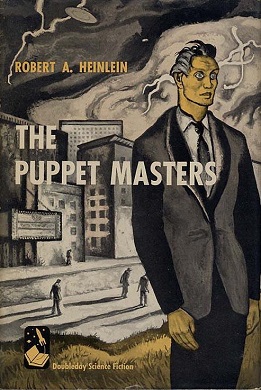
That is: I reread stories and books that have made deep, lasting impressions, the better to understand why (or if, upon reexamination) those pieces resonate with me. Most recently, I reread classics by two masters of the genre: The Dragon in the Sea, by Frank Herbert (1955), and The Puppet Masters, by Robert A. Heinlein (1951). Both are, in quite different ways, Cold War novels.  From there, the two diverge.

The Dragon In the Sea  is a novel of submarine warfare, set in a future clearly evolved from the early Cold War. The West is in a death struggle with the "Eastern powers," with Russia chief among them. Dragon is an overt Cold War adventure melded with a psychological thriller, as physical and mental pressures build on one submarine's crew
The storytelling is in third-person-limited point of view (POV) -- that is, we're in the heads of every member of one sub's crew, never knowing more than they know.

Frank Herbert, of course, is a master. He breaks two cardinal rules of modern SF -- and for him, it works. There's lots of detail about futuristic submarines and the mechanics of sub/sub duels -- as much a military procedural as an SF novel. The amount of detail explicitly conveyed would be disparaged today as an "info dump."

The other surprise to the modern reader: we sometimes jump from one character's head to another within single scenes. That, too, is contrary to modern style. I'll admit that I occasionally found those (non)transitions jarring.

The Puppet Masters involves extraterrestrial parasites who take control of humans (decades before the Go'a'uld of the Stargate franchise), the takeover being all but undetectable. The novel is often taken as a parable of Cold War paranoia.

Monday, June 20, 2011

Hackpocalypse now

Is it only me, or is the world becoming eerily (and scarily) reminiscent of Neuromancer, Snow Crash, and True Names?

That is: is conflict moving from the physical to the virtual domain? Are freelance hackers and ad hoc groupings of same obtaining more and more influence over our daily lives? Is hacking the new, preferred choice in asymmetric warfare? Are we neck deep in a new, scary era?

It sure looks that way. Consider these recent events:

Tuesday, November 24, 2009

Thanksgiving appetizers


Thanksgiving makes for a shortened work week (and yet here you are, surfing), and the turkey et. al. aren't going to eat themselves. 

I'm going to post this ahead of The Day, before the blogger (and perhaps a reader or two) succumbs to a tryptophan stupor. So, herewith a few pre-holiday mental appetizers ...

Friday, May 15, 2009

Trope-ing the light fantastic (alien abductions)

When The X Files first aired (September 1993), I was a few months into the start-up of a major development program for NASA. (A part of the Earth Observing System, if anyone wonders. EOS was the third largest program at NASA, after the ISS and the shuttle.) The X Files, among other things, went by the wayside.

Recently, having finished my trip down Star Trek / memory lane -- Netflix being a wonderful institution -- I began watching The X Files. It can be entertaining, no doubt, but alien abduction? I just don't get it.

If aliens traveled the vast distances from ... wherever to Earth, it's conceivable they would abduct a few people to -- figuratively -- pick their brains. Having said that:

1. If ET understands humans well enough to selectively recover data from and/or edit our brains (alien abductions in fiction and tabloids tend to involve repressed memories), why can't they -- much more simply -- find out what they want to know by watching our TV, listening to our radio, and tapping our Internet? If ET abducted Nobel Prize winners and high-ranking officials, they might learn something they couldn't just pick out of the ethers. That's not who we hear is being abducted. What that's unique would ET learn kidnapping random folks on lonely country roads?

2. Suppose ET did abduct people. Why bother to suppress their memories and put them back? Not morality: ET has (in this supposition) kidnapped and altered the memories of people. That doesn't sound like ET has much respect for humans. Not to keep his presence secret: ET must by now know (in this supposition) that lots of abductees recover their memories. Whereas lots of people disappear without a trace all the time ... look at these FBI missing person statistics.

In short, I don't see the logic in ET abducting random humans. If ET did, I don't believe he'd keep putting them back where he found them despite, apparently, decades of failures in memory erasure.

So for SFnal purposes, I'll conclude alien abduction is a trope.

(As we are approaching tabloid territory, a true confession: I once tiptoed around the edges of committing the alien-abduction trope. In Moonstruck, my first-contact novel, aliens do abduct people -- but the aliens do not put anyone back. And there's a good reason why abducting regular Joe types makes sense. I won't be any more specific lest I ruin the book for anyone.)

All that said ... many people BELIEVE in alien abduction. There are plenty of books and articles that take the subject seriously -- without much in the way of evidence. Recovered memories? Not evidence, because recovery of repressed memories is a rather suspect mechanism. As the American Psychiatric Association says (here), "At this point it is impossible, without corroborative evidence, to tell a true memory from a false one."

Phew! That was a lot of words ... I think I'll go unwind in front of another episode of The X Files.

Monday, May 11, 2009

Is that all there is?

May's theme for the Year of Science is "Celebrate sustainability and the environment." To which, for the first time in the YoS program, I say: Bah. And: Faugh. And: How disappointing.

Wait a bit on the torches and pitchforks.

By all means, let's study how the environment works. Heck, we live in it. And wouldn't it be great if we came to understand how to build a stable biosphere. It'd be handy for, say, long-term spaceflight or establishing off-world colonies. And certainly I have no quarrel with efficiency.

That's no reason to make a goal of "sustainability."

I find sustainability fatalistic and inward looking, lacking in ambition. Whether I put on my technologist hat or my SFnal specs, I have to ask: why should our aims -- and our imagination -- be so limited?

There's an entire UNIVERSE out there. Why isn't our ambition to tap a few off-Earth resources? Why don't we consider moving the dirtiest industries someplace -- in orbit a thousand miles up, say, or on the moon -- where sunlight is unfiltered by atmosphere and unaffected by weather? Someplace where pollution won't matter? Why don't we think about moving out to the moon, and Mars, and the Belt?

The universe, presumably, is a zero-sum game. But one tiny planet? We're nearing the level of technology at which Earth limits us only if we let it.

To me, sustainability is less about science than it is a mass movement. And the sad thing about sustainability as a goal, and about those situations where environmentalism becomes religion or politics, is that once we lower our sights it becomes all to easy to forget how to raise them.

Sunday, May 3, 2009

Death by the numbers

Swine flu (or whatever is the preferred name for the disease today) is a serious matter. Some have died; more have been sickened. For them and their family statistics hardly matter.

Then there's the rest of us ...

The death toll in the US from the recent, endlessly ballyhooed disease is -- one. To put that in perspective, check out leading causes of death in 2005 in the US (latest available complete data, from Centers for Disease Control):
  • Heart disease: 652,091
  • Cancer: 559,312
  • Stroke (cerebrovascular diseases): 143,579
  • Chronic lower respiratory diseases: 130,933
  • Accidents (unintentional injuries): 117,809
  • Diabetes: 75,119
  • Alzheimer's disease: 71,599
  • Influenza/Pneumonia: 63,001
  • Nephritis, nephrotic syndrome, and nephrosis: 43,901
  • Septicemia: 34,136
Again according to the CDC, about 80 people in the US die annually from lightning.

I don't know about you, but to me the swine-flu coverage (and concern) seems more than a little disproportionate.

Meanwhile, our vice president has responded to this situation by announcing he's advised his family to avoid air travel and mass transit. That doesn't exactly give me a warm-and-fuzzy about how clearheaded would be his response to other issues that may come his way. (My guess: If Bush 43 had been the one to make that statement, the press would be pillorying him.)

As an exercise in sociology, press and government reaction to the outbreak is fascinating. As public policy ... ugh.

Thursday, March 26, 2009

Alien aliens (group minds)

Hive minds have fascinated people since before SF began.

I refer, of course, to that prototypical hive: that of bees. It's long been noted that many types of insects -- individually far from intelligent -- exhibit complex group behaviors and build complex structures. Complexity within groups emerges from the seemingly simple behavior of the individual units.

It's not only insects. Flocks, for example, exhibit behaviors that result from the unsophisticated reflexes of individual birds. ("Bird brain" isn't an insult for nothing, nor "silly goose.")

The overall phenomenon is called emergence. If you are of a computer-oriented frame of mind, you may prefer the term cellular automata. Either way, the fascinating thing is complexity arising out of simplicity and large numbers. One theory of human intelligence is that it emerges from the 100 billion neurons (and 100s of trillions of synapses) in each of our brains.

The natural emergence of complexity -- and perhaps, intelligence -- from large numbers of simple units is so attractive it may be the leading fictional premise for the emergence of an artificial intelligence. Certainly I've introduced AIs that way (in only some of my AI-centric stories.)

The SFnal (and sociological) question becomes: if sophistication emerges from collectives of simple creatures, what might arise from collectives of intelligent creatures?

We have plenty of good SF to choose from. To name a few personal favorites:
  • the dog/wolf pack-like Tines of A Fire Upon the Deep (Vernor Vinge)
  • the multi-species Borg of the Star Trek franchise.
  • the hive humans of Hellstrom's Hive (Frank Herbert).
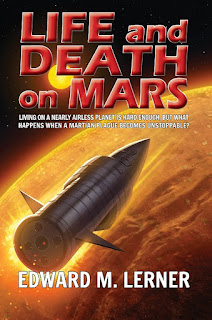
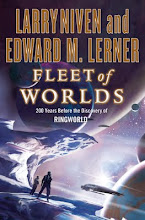
  • the group ensembles of the starfish-like Gw'oth (with the individual Gw'o in turn descended from a colony of carnivorous worms) of Fleet of Worlds (Larry Niven and Edward M. Lerner).
Collectives and emergence -- hive minds -- are a great way to make alien aliens, even with humans as building blocks.

Wednesday, December 31, 2008

Trope-ing the light fantastic (aliens)

Oh, come on.

Admit it: That (or some more colorful phrase of disbelief) is what you're thinking. How can aliens be only an SF trope? In such a huge and ancient universe, how can I dismiss the possibility of alien life elsewhere and elsewhen?

I don't. In fact, I plan to start a new series of posts in the new year dedicated to alien aliens.

This post is about non-alien aliens. You know the type: humans thinly disguised as aliens. Such species have served as stand-ins for Cold War allegories (e.g., two neighboring worlds locked in a war whose origins no one really understands), racial parables (e.g., two species on the same world, one pointlessly oppressing the other), and strawmen to advocate for (or against) birth control or euthanasia or gender equality or darn near any sociological pattern. When the medium is visual, these aliens are humanoid in appearance -- wouldn't want to be too subtle.

Near-certain signs of a trope alien: the aliens are cross-fertile with humans or (like decades of lurid pulp-magazine covers) find members of the other species sexually attractive.

There's no plausible basis for such aliens. Parallel evolution, you say? True, octopi have eyes much like humans -- but we can't bear each other's children! Panspermia? Suppose common seeds of life did drift, eons ago, to both Earth and Mars (or Earth and Rigel III). Since then, there's been a whole lotta evolution going on -- on both worlds. I have more genes in common with a redwood or a rattlesnake than a human can have in common with any extraterrestrial cousins.

Alien aliens: real SF. (I'd like to say meat-and-potatoes SF, but I'm guessing aliens aren't edible, either.) Stay tuned for next year's new series.

Social stand-in aliens? Trope. (Not that there's anything wrong with that.)

Monday, October 13, 2008

Iceland meltdown

The current global financial crisis somehow feels SFnal, futuristic, cyberpunk, to me.

Much wealth -- as varied as commodities futures, options on stocks, and credit default swaps -- is no more than entries in computers. Information. Or maybe disinformation. The value of the underlying "assets" is a collective state of mind, subject to mood swings -- and so, to hysteria (er, news). Or, for anyone with a conspiratorial belief system, to manipulation.

And so Iceland, a thoroughly developed country, goes almost overnight from wealthy to broke (e.g., see this USA Today story), its metaphorical hand extended for aid. Iceland is hardly the only problem spot, of course, merely (IMO) the poster child for the current crisis.

I don't mean to exonerate or excuse any particular institution. In the case of Iceland, for example, accepting bank deposits equal to about ten times the GDP looks -- in retrospect, anyway -- like a really bad idea. An SFnal, post-national, bad idea.

It's not the future I was looking for ...

Friday, September 19, 2008

Psycho history

What else do you call it when the Dow is down 500+ points Monday and up 400+ points Thursday (and up another 300+ points so far today, Friday, as I type)? When panic and rumor drive the markets? When the government and central banks make enormous new funds injections, nationalizations, and regulatory changes on a daily basis?

Psychohistory, of course, is the imaginary future social science at the heart of Isaac Asimov’s Foundation series. Blending history, sociology, and statistical analysis, psychohistorians predict the course of societal evolution, and even find the occasional tipping point from which events can be nudged onto a different course.

We are far from having such abilities.

Giant financial companies like Fannie, Freddie, and AIG, with trillion-dollar portfolios, are built on statistical analysis. History, one hopes, plays some role in executives’ understanding of current events and future prospects. History also guides government policies towards markets and regulation. I’ll assert that the processes of any large organization -- whether a corporation, government, or market -- are, at some level, a study in applied sociology.

(Some might argue that the credit crunch and attendant market implosion reflect economics, not sociology. To that opinion, I would answer: Economics describes how a society agrees to allocate its collective resources. If/when/how society regulates its economic institutions -- i.e., how it sets government’s role -- is likewise part of the social compact. If economics isn’t soc, it’s surely akin.)

Now giant financial companies are falling like dominoes. They are, to some part, victims of their own greed -- but also of investor panic. Old fashioned, rumor-driven runs on the bank. Mass phenomena. Within the realm of sociology. And the experts -- inside and outside of these companies -- didn’t see it coming.

Where was Hari Seldon when we needed him?