Showing posts with label known space. Show all posts

Tuesday, June 12, 2018

Today, it's official. And still epic.

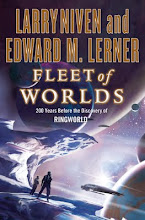
Tor Books today released a discounted five-ebook bundle of the entire Fleet of Worlds series. That series is my joint venture in Known Space with Larry Niven.

(What about the Other Good News hinted at in last week's preview of today's release? That independent event came a few days earlier than I'd anticipated, and I posted then. So: if you only drop by here Tuesdays, my typical posting day, and so missed my out-of-cycle celebratory post Woohoo!, you may want to check it out, too. Stat. Trope-ing the Light Fantastic: The Science Behind the Fiction (ebook) won't remain on deep-discount for long.)

But let's get back to the Fleet of Worlds series, and the news of the day ...

Fleet series ebook bundle on AmazonBottom-lining it: This is an epic offer on an epic -- and much acclaimed -- hard-SF story line that spans centuries and light-years. A story line with: Existential dangers. Larger-than-life deeds, both villainous and heroic. Truly alien aliens. Amazing advanced technologies.

How epic? Here's my favorite blurb per novel (in series order, from first to last):

Tuesday, June 5, 2018

Talk about epic!

On June 12, Tor Books will be releasing a discounted five-ebook bundle of the entire Fleet of Worlds series. That's my joint venture in Known Space with Larry Niven.

Why the advance mention? Because there is Other Good News in the pipeline to be announced next week :-)

And any of the major ebook providers will be happy to queue up your order ....

Fleet series ebook bundle on AmazonBottom-lining it: This is an epic offer on an epic -- and much acclaimed -- hard-SF story line that spans centuries and light-years. A story line with: Existential dangers. Larger-than-life deeds, both villainous and heroic. Truly alien aliens. Amazing advanced technologies.

How epic? Here's my favorite blurb per novel (in series order, from first to last):

Monday, October 16, 2017

Fleet of Worlds: The Tintinnabulation

On October 16, 2007, Fleet of Worlds was first published. That is: ten years ago to the day.

Larry and Ed at 2015 Nebula weekend
This epic space opera, a collaboration with Larry Niven set in his Known Space future history(*), remains my most popular title. Fleet of Worlds has been translated into eight languages. It was selected (by what was not yet called the SyFy channel) as a Sci Fi Essential title, had a slot as a Science Fiction Book Club featured book, and was a finalist for a Prometheus Award.

(*) Which isn't to say that Fleet assumes the reader is familiar with any other story or book. But if you are a Known Space aficionado? If the name Beowulf Shaeffer rings a bell, or the title Ringworld elicits fond memories, I'm happy to say Fleet offers you the occasional Easter egg ...

Monday, May 8, 2017

MY life, the universe, and everything

File 770, the acclaimed genre website, this morning posted an extended interview/profile of my writing career. I'll crib their introduction rather than adding yet more words:

Retired professional scientist Edward Lerner talks about a host of hard science fiction topics, plus his collaboration with Larry Niven, his participation in SIGMA, and his nonfiction column for Analog.

Check out, if you're curious (and really, given that you're already here, you know you are), Edward M. Lerner: Crafted Science, Convincing Characters.

Tuesday, March 1, 2016

Greetings, Known Space fans!

Tor Books has just (re-)released, as a two-novel combination, Larry Niven's Ringworld's Children and (by the both of us) Fleet of Worlds. That's quite the volume!

(I use "volume" loosely -- the combo is available as an ebook, too, of course. We're not cavemen.)

A two-fer
Click for the two-fer
Ringworld's Children is the last of four Niven-only Ringworld novels. Fleet of Worlds, which opens 200 years before Ringworld, begins our acclaimed companion series -- while revealing more about the famed Puppeteers than the four Ringworld novels combined. And about Nessus, too :-)

"Action and clever world building should captivate newcomers to Ringworld, while returners will appreciate picking up loose ends from previous Ringworld volumes."
-- Booklist (on Ringworld's Children)

" ... Needs recommending within the science fiction community about as much as a new Harry Potter novel does – well, anywhere."
-- Locus Magazine (on Fleet of Worlds)

New to Known Space? Just been away for awhile? Here's a great opportunity to (re)visit the grandest future history of them all. As the copy writer proclaimed on the cover: "Two masterpieces of science fiction. One price."

Tuesday, June 10, 2014

Fate of Worlds redux

What we have here is bookends. (Also: a commercial announcement.)

Worlds without a star, hurtling through space ...

In a beginning ...
Fleet of Worlds, my first collaboration with Larry Niven, got rave reviews, was a Prometheus Award finalist, was a Science Fiction Book Club featured title, and -- though we wrote the novel to stand alone -- morphed quickly into a series. Most major-publisher titles these days come out in hardback, mass-market paperback, and ebook formats; I was delighted when, four years after Fleet first appeared, Tor Books reissued the novel in trade paperback format.

More aliens than you can shake a laser blaster at, nursing as many grudges ...

Amazon link, TPB edition
So: I'm yet more delighted that today -- not even two years after the original publication -- Tor Books is re-releasing Fate of Worlds: Return from the Ringworld, the final book of the series, as a trade paperback.

Bookends, I say again :-)

Tuesday, April 15, 2014

Going postal. Or: The stats, stat.

About three years ago I first compiled a list/overview of what were then the most visited posts here at SF and Nonsense. To my surprise, Postscript (or is that post post?) was itself instantly popular. It remains third on the all-time list.

And so, an annual tradition was born. 

Serious posts :-)
From a stats snapshot I captured a few days ago (thanks, Blogger!), here's the complete all-time top-ten list.

Of moons, clouds, and the state of the art(s), a general science-and-tech news post from August 2013, shot straight to the top of the list. I found these items interesting -- but no more so than news I've highlighted in many other posts. I offer no theories why this specific post is so popular.

(If any readers care to offer an opinion, that'd be keen.)

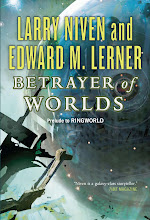
Number two, slipped from the lead position last year, is Betrayer of Worlds, the October 2010 announcement of a novel's original release. This novel being fourth in a five-part series, the persistent popularity of its post is also something of a puzzler.

Number three, as already noted, is Postscript (or is that post post?), the original posting stats.

Tuesday, July 2, 2013

Fate of Worlds: the MM PB

Today marks the mass-market paperback re-release of Fate of Worlds: Return from the Ringworld. It's the explosive conclusion to the Ringworld series and the Fleet of Worlds series of epic SF adventures. With this edition finally available, all five books in the series are available in mass-market format. 

(And if you're an ebook aficionado? There's still news. In anticipation of the paperback re-release, the Kindle price just dropped. The ebook in other formats will surely follow suit.)

Check it out on Amazon
What, specifically, is Fate about? I'm glad you asked! It's interstellar conflict among five intelligent species (if you're an aficionado of Known Space: humans, Kzinti, Trinocs, Puppeteers, and Gw'oth) and an AI. It's the answer to countless questions across the Ringworld series. It settles, quite literally, the fate of worlds.

Tuesday, April 9, 2013

The poster child for, well, posts

Welcome to the third annual review of popular posts and topics here on SF and Nonsense. The first such round up, Postscript (or is that post post?), continues to run a strong second place in all-time popularity among my posts.

The winner is ...
The most popular all-time post? That continues to be, in a cake walk, the October 12, 2010 post Betrayer of Worlds. It's hardly intuitive that the announcement of book four (of five) in the Fleet of Worlds series (with Larry Niven) should be so popular. My theory is that a page name that is a straight book title -- rather than my wont, a play on words incorporating the book title -- ranks higher in Google's secret search algorithm.

Number three, down a single peg from second place in previous years, is Trope-ing the light fantastic (life-sign detectors) (from February 25, 2009, about a particular SFnal trope). Does this post draw Star Trek fans? Biologists? I don't know. Other entries in my Trope-ing the light fantastic post series aren't as popular.

Ranked fourth (up from sixth a year ago), from February 11, 2011, we have Creative Destruction. That's another Lerner book title, drawing upon the concise description of capitalism by economist Joseph Schumpeter.

To those of you Googling the phrase "Creative Destruction" out of dismal-science curiosity, two comments. First, my Creative Destruction -- a themed collection of eight stories, ranging from flash fiction to a short novel -- deals with computer science. IMO, computer science is a primo example of Schumpeter's virtuous cycle of the better supplanting the no longer competitive. Second, beyond my techiness, I have an MBA.

Tuesday, April 2, 2013

Quoth the Gw'oth ...

I won't say nevermore—if only because never encompasses a very long time—but there are no plans for further novels in the Fleet of Worlds series. And so ...

Debut of the Gw'oth
I invented the Gw’oth for Fleet of Worlds (coauthored with Larry Niven); the little guys returned in three (of the four) sequels. As often happens with species- and world-building, much background is merely hinted at in the eventual story or is omitted entirely. That’s okay. I needed to understand the Gw’oth before putting them through their many-tentacled paces. Hence: four novels after their debut, some details about the Gw’oth remain untold.

I recently wrote "Alien Aliens: Beyond Rubber Suits" for the science side of Analog Science Fiction and Fact (see the April 2013 issue). The Gw'oth served in the article as an extended example of how an author might go about creating alien worlds and alien aliens.

If you read the zine (and if you enjoy hard SF, you really should), check out the article. And if you don't? Read on for an extract (slightly adapted) from the article for a peek at the science and thinking behind the Gw'oth.

But be advised: bits of what follows are spoilers for Fleet of Worlds (though not the remaining books of the series) ...

Friday, February 1, 2013

Permit me a small woohoo!

A most satisfying day ...

Locus magazine's recommended reading list for 2012 was released today, with (we pause for a tasteful drum roll ...) Fate of Worlds among its chosen SF novels. Lots of great reading is to be found on that list ...

Also today, SF Site published Fate of Worlds: An Interview with Edward M. Lerner. It'd be hard not to be pleased by (from the intro to the interview):
"In August of 2012 came Niven and Lerner's capstone to both the Ringworld and Fleet series, Fate of Worlds, which closes out both series in a single triumphant work of vivid imagination and colorful adventure, fraught with enough action, intrigue, surprises and human drama to satisfy any SF fan."
Today, not even single-digit wind chill phases me.

Friday, December 7, 2012

A note to my UK readers ... kindling

(Last updated January 10, 2013)

For the longest time, my Fleet of Worlds series novels (with Larry Niven) have been unavailable in the UK for download to the Kindle. I won't bore you with why, but -- as of today -- the fifth and final volume is here (or, from my perspective, there).

Now available for the Kindle at amazon.co.uk:

(If this was all Greek to you, click any series cover thumbnail on the right-hand side.)

It's a Festivus miracle!

Monday, October 29, 2012

As I was saying ...


Several weeks ago I recorded two interviews, one on radio and a second on TV. Both interviews are now streamable.

On the radio program Cover to Cover Book Beat, Larry Niven and I discuss Fate of Worlds (and, to some degree, the entire Fleet of Worlds series).

On cable TV, Fast Forward: Contemporary Science Fiction interviewed me about both Energized and Fate of Worlds.


Although I usually post on Tuesdays, I'm posting this today lest I have a Frankenstorm blackout or comm outage. Wish me luck.

Tuesday, September 11, 2012

Of the Ringworld, the Fleet of Worlds, and the Worldcon panel that wasn't

Many visitors to this blog are familiar with the sprawling, enduring future history that is Known Space. They know about Larry Niven's Ringworld novels and Larry's and my Fleet of Worlds novels. They know that Fate of Worlds: Return from the Ringworld, newly published, is the finale to both series.

In the beginning
And so, regular visitors to SF and Nonsense may not be surprised to read that Larry and I envisioned a panel at the just concluded Worldcon at which we would field moderator and fan questions about the two interrelated series.

(Which isn't to suggest that you can't read these books standalone. You can -- and more on that later. But the more Known Space books you read, the more connections you'll see.)

Alas, circumstances kept Larry from attending the con, and the panel didn't happen. And I'd hate to see my in-advance musing about likely questions go to waste ...

In the following Q-and-A with myself, I've tried to keep spoilers to a minimum. That said, read on at your own peril.

Tuesday, April 10, 2012

Post postscript

About a year ago (April 12, 2011, to be precise), I commented here on Google's first full year of statistics  regarding post popularity on SF and Nonsense.

Effectively a year later, Betrayer of Worlds (October 12, 2010) remains -- by better than three to one! -- my most visited post.  It's also, and by a similar margin, the post most often commented upon. (My Fate of Worlds post -- you know, surely, that one is coming -- has its work cut out for it.)

Number two in cumulative popularity remains Trope-ing the light fantastic (life-sign detectors) (February 25, 2009). Number 3, however, is new to the tabulation -- the self-referential Postscript (or is that post post?) in which I announced last year's SF and Nonsense post-popularity statistics. The way things are trending, in a few months Postscript will move up to second place.

With that much interest, I thought: this should be an annual feature. And so here we are.

Tuesday, March 6, 2012

Ice, water, and fire

Google searches on "Gw'oth" are among the top referral sources to this blog. Reader emails and (at cons and signings) in-person questions that I'm asked also often relate to the Gw'oth.

Europa: ice, cracks, and all
(The Gw'oth, if the word doesn't ring a bell, are aliens who feature prominently in the Fleet of Worlds series of space operas that I write with Larry Niven. The Gw'oth evolved on a world somewhat  like Jupiter's moon Europa, in an ocean beneath the ice. Above the ice lies deadly vacuum. A Gw'o (that's the singular) is an aquatic creature who looks something like a starfish crossed with an octopus. I gave a more detailed physical description in the post Gw'oth revealed! And other fun stuff).

And the question that I am most often asked about the Gw'oth is: living underwater, how did they ever develop technology? Doesn't it take fire to develop technology? As regards non-biological technology, my guess -- like many readers' suspicions -- is: yes.

Wildfires were a part of our forbears' natural environment. Fire was possible in our forbears' natural environment. How the Gw'oth would master (or encounter) fire underwater is less than intuitive ....

One such reader question came up several weeks ago, far down in a thread of comments about a merely semi-related post. I answered with another comment in that same thread, but on reflection, I decided to address the topic in a post of its own. A post that people Googling "Gw'oth" will more readily find. This post.

There aren't major plot spoilers in my answer; I'm dealing primarily with back story before the opening of the series. Before humans and other species of Known Space ever met the Gw'oth. But if you continue, know you will encounter snippets of plot and text from a couple of the books.

Continue as you think best ...

Tuesday, January 24, 2012

Of the Ringworld (and much smaller things)

Lots of Known Space aficionados frequent this blog.

Especially if you're one of them, here's a stunning short video I happened upon, inspired by early portions of -- by my colleague, Larry Niven -- the novel Ringworld Seriously cool. (And if you haven't read Ringworld ... you should. It's won about every SF award there is.)


I hope there will be a Part 2.

Tuesday, November 8, 2011

Fleet of Worlds (at last)

I've blogged regularly about the Fleet of Worlds: the physical (however fictional) place; the most recent book in the series; the various species known to the Fleet's alien denizens, the Puppeteers; the exotic technologies used there (and elsewhere in Known Space); and relationships to Larry Niven's novel Ringworld and its series.

But I've never blogged about Fleet of Worlds the novel, even though it kicked off the Fleet of  Worlds series (more on that below) and is among my most popular books. Fleet of Worlds was released in 2007 -- but I didn't begin blogging till 2008. I never saw a reason to look back

Till now. Today, Tor Books (Larry's and my publisher) re-released Fleet of Worlds as a trade paperback.

What is Fleet of Worlds about?

Monday, September 26, 2011

Humans, Pak, Puppeteers: in one word

An exercise: describe humanity in one word.

Choose carefully. The term you pick must apply universally across nationalities, ethnicities, cultures, technology levels, and political systems. It must apply equally across thousands of years of history, today, and well into the future.  The term should also serve to predict the behavior of an individual person in any situation, independent of his or her past experiences, throughout his or her adult life.

Hmm. Humans can be cruel, selfish, and ruthless -- but we can also be altruistic, generous, and self-sacrificing. We can be curious, but we can also be oblivious to events all around us. We can be inventive or mired in tradition or anti-intellectual, slapstick or witty or humorless, adventuresome or stay-at-home. We love and hate. We can be suspicious, sympathetic, and gullible. We act both capriciously and with cold, calculating premeditation.

I'm not having a lot of luck with my own challenge.

I succumb on occasion to checking out comments about my own books, both by professional reviewers and by (via Amazon and Goodreads, for example) the general readership. Most authors do. And while it's always enjoyable to see praise, critiques provide more in the way of learning opportunities. As in: What aspects of a plot did some readers not accept? What character behaviors did some readers find implausible? What background elements might have been insufficiently described?

So: How does that exercise of authorial due diligence (or rationalization -- another human trait) have anything to do with today's challenge?

Tuesday, July 12, 2011

Gw'oth revealed! (And other fun stuff)

Several Known Space alien species have been imagined by artists, both pro and fan. But not yet every species, and I've been eager for someone to visually capture the essence of the scary-smart, aquatic Gw'oth. I think that's natural, given that the Gw'oth are prominent among my contributions to Known Space. (If this paragraph isn't obscure enough, I'll be forthright: its neat images aside, this post is aimed largely at Known Space aficionados.)

What are the Gw'oth? These aliens [singular: Gw'o] were introduced in the novel Fleet of Worlds; they went on to figure prominently across the Fleet of Worlds series. Most important among the Gw'oth are the very few individuals who together can form -- what I can't characterize further without spoilers -- into a special group called a Gw'otesht.

What do they look like? I'm happy you asked. Here's a descriptive passage from Destroyer of Worlds:
     A Gw'o had five limbs arrayed about a central disc, sort of like a starfish. Spines covered the skin, again like a starfish. There the resemblance ended. A Gw'o's skin changed colors like a squid or octopus. Its appendages were flexible, like those of an octopus, and hollow like tubeworms. Tier after tier of sharp teeth ringed the inner surface of each tube. Eyes and other as-yet unidentified sensors peeked out from behind the teeth. Almost certainly Gw'oth had evolved from some type of symbiotic carnivorous worm colony. Yes, Gw'oth had become familiar, singly and in groups. Except--
      Fascinated and repulsed, Sigmund examined a pile of writhing Gw'oth. The archival image was flat -- in the era of Explorer’s visits, the Gw'oth had yet to develop holography -- and for that Sigmund was grateful. Those piled, pulsing tubes, ends swallowing one another, the throbbing flesh, the occasional limb disconnecting and groping free of the twisting mass (to breathe?) came just a little too close to ... what? A spill of loose intestines? A nest of snakes having an orgy?
 I took a bit of a vacation last week, during which I dropped by the Museum of Fine Arts in Boston. And what did I discover at the MFA but -- most extraordinary! -- the Dale Chihuly exhibition of blown-glass sculptures. Through the Looking Glass, the exhibition is called -- but Alice was not the fictional character who came to my mind. 

So: you see me here with a Gw'otesht on a lunch break.

The Gw'oth are predators. Happily they settled for those purple worms instead of my arm :-)