Tuesday, February 8, 2011

Techno-copia

Several items of likely interest to the SF (and just S) readers of this blog ...

What if robots could share what they learn?  Is that a step toward Skynet or just towards less dumb robots?  Check out RoboEarth: a Worldwide Web for Robots

(Robots interacting with the real world is a hard problem. My grad-school days are long passed, but back then I shared an office with a guy whose doctoral dissertation involved programming a robotic arm to ... stack blocks.)

Tuesday, February 1, 2011

Of fleet Fleets and Known Space

(Updated August 21, 2012, to reflect the release of Fate of Worlds)

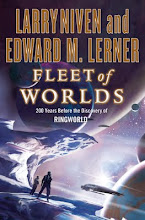
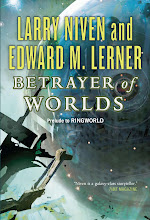
Readers often email me to discuss fine points of Known Space lore, including how the Fleet of Worlds series of collaborative novels relates to other books and stories within Larry Niven's Known Space future history.

Behold: the Fleet!
(No spoilers herein. In this post I'll say little or nothing about plots. For per-book descriptions click embedded links to go to the book-specific Amazon pages. For books in the Fleet series, you can also click the book covers on the right-hand side of this post page for more description.)

Erroneous web references abound that Fleet/Juggler/Destroyer of Worlds are a trilogy (they're not), and that Betrayer of Worlds is the first of a series (a new sub-series is more accurate, in that Betrayer introduces a new main character), and wondering if the series is complete (as of today's update, with the release of Fate of Worlds, #5, it is).

Other online articles -- from mainstream reviews to fan sites to blog posts -- offer conflicting opinions as to whether and how individual Fleet of Worlds series books relate to earlier-written Known Space stories -- and even to each other.

You know what? I thought I'd offer an opinion.  Being a coauthor imparts some qualifications, right?

Tuesday, January 25, 2011

Antimatter matters

One of the biggest mysteries of physics (and life, the universe, and everything)  is this: why is anything even here?

In physics, the question crops up at two levels. First, why did the Big Bang happen? Second, once the Big Bang did happen, matter and antimatter were, per theory, created in equal quantities. So: why didn't the universe's matter and antimatter eradicate each other and leave behind nothing but energy? 

(I'm not complaining that we're here. Merely puzzled.)

Monday, January 17, 2011

Cyber war

If you visit this blog with any regularity, you'll know that I'm a technophile. That said, for all the many wondrous things technology offers, it also creates new ways to become vulnerable. One vulnerability I particularly monitor is attacks on our increasingly networked infrastructure.

Recent years have offered inklings of cyber warfare. 

Tuesday, January 11, 2011

Getting smashed

No, not a New Year's Eve hangover retrospective.  Rather, reflections on the near-term prospects for particle accelerators (what in my youth we called atom smashers).

UPDATED FEBRUARY 1, 2011

First came word that the brand-new, scarcely operational Large Hadron Collider would will shut down for maintenance throughout 2012. Then CERN, the trans-European organization that runs the LHC, announced the shutdown will last more than a year and that they'll also be shutting down the rest of their accelerators in 2012.

UPDATE (2/1/2011): CERN has reconsidered. The LHC will continue running in 2012. Yea!

Now comes word that FermiLab plans to turn off the Tevatron later this year.

Monday, January 3, 2011

Head in the clouds

One of the hottest ideas in information technology these days is "cloud computing."

The expression originates in an early Internet convention: customer-centric drawings that showed detail of Internet connectivity only at the end points. That is, you're likely to care how your computer (or phone) connects to the Internet. You're likely to care about the server that's providing a function to you. And the gear that lies between? The redundant components and fail-over mechanisms and keen in-the-background software that make the Internet resilient? For most end users, not so much.

To network engineers, those "between" things -- routers and comm links and protocol stacks and specialty servers for background functions like domain-name look-ups -- are, collectively, "the cloud." And so, many a network diagram (like the one nearby) shows connections into and out of a featureless cloud.

Monday, December 27, 2010

Spacing out

As the year wraps up, some miscellaneous space news ...

One of the most fascinating results to come from the Apollo program concerned the longstanding puzzle of the origins of Earth's moon. (Our moon is anomalous, most visibly because it is so large compared to the planet it orbits.) The conclusion, based upon rock samples collected on the lunar surface: the moon likely resulted from the cataclysmic collision of a Mars-sized object with the (then very young) Earth.

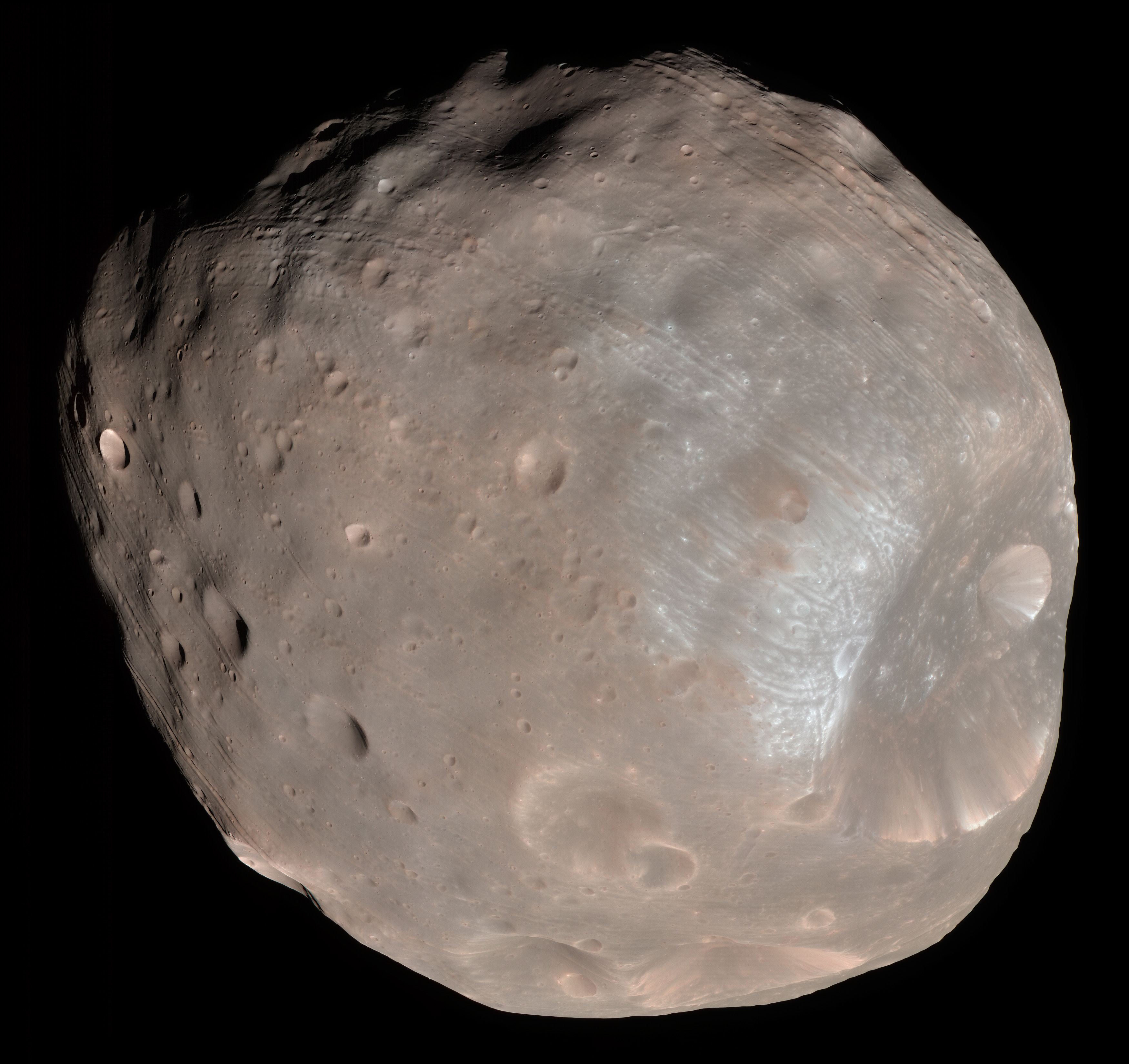
This year's semi-related news item concerns Phobos, Mars's largest (but still tiny) moon. (The nearby picture is a [color-enhanced] image of Phobos taken by the Mars Reconnaissance Orbiter.) Phobos likely formed from a smaller impact with Mars itself.

The space-shuttle fleet will be retired in 2011. For the foreseeable future, the US will have to pay the Russians for crew rides to the International Space Station. As disappointing as is that situation (I've commented on it before), at least getting supplies to the International Space Station aboard American spacecraft just became more credible with the successful test flight of Space-X's Dragon.

Wednesday, December 22, 2010

History sniffing

My concern/dismay(/obsession?) about privacy -- or modern lack thereof -- has been fed again ...

It seems that the websites you visit can access (through your browser) the history of other websites you've visited. The practice is called "history sniffing," and I, for one, find it disturbing.