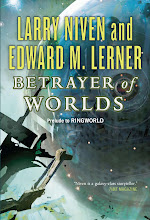
Perhaps it's impossible to be serious when Sirius rises with the sun (see: Dog Days). And though my currently running serial in Analog is Energized, the current heat wave has rendered me enervated.
(But even when I am serious, I stay current with the goings-on aboard the space station RU Sirius. If you haven't discovered Brewster Rockit, you should.)
But two Eds, you say ...
Tuesday, July 26, 2011
Because two Eds *are* better than one
Monday, July 18, 2011
National navel-gazing
As Atlantis prepares to return to Earth, ending the era of the space shuttle, we have the discouraging news that Congress may cancel the James Webb Space Telescope, NASA's long-planned successor to the Hubble.
The Hubble Space Telescope is, simply put, one of the greatest observatories ever built. The discoveries it made possible are simply astonishing. The ability to service and upgrade the HST on-orbit -- done five times! -- has been one of the few unambiguously good reasons to have space shuttles. Without the shuttle, the Hubble will die, and we'll have no way to repair it the next time.
Why cancel the JWST? Money, of course. It is over budget, by a not-insignificant $1.5B. But this telescope is exceedingly advanced tech. What high-tech project hasn't overrun its budget a bit?
The Hubble Space Telescope is, simply put, one of the greatest observatories ever built. The discoveries it made possible are simply astonishing. The ability to service and upgrade the HST on-orbit -- done five times! -- has been one of the few unambiguously good reasons to have space shuttles. Without the shuttle, the Hubble will die, and we'll have no way to repair it the next time.
Why cancel the JWST? Money, of course. It is over budget, by a not-insignificant $1.5B. But this telescope is exceedingly advanced tech. What high-tech project hasn't overrun its budget a bit?
Posted by
Edward M. Lerner
at
2:54 PM
Labels:
current events,
rant,
science,
space exploration,
technology
Tuesday, July 12, 2011
Gw'oth revealed! (And other fun stuff)
Several Known Space alien species have been imagined by artists, both pro and fan. But not yet every species, and I've been eager for someone to visually capture the essence of the scary-smart, aquatic Gw'oth. I think that's natural, given that the Gw'oth are prominent among my contributions to Known Space. (If this paragraph isn't obscure enough, I'll be forthright: its neat images aside, this post is aimed largely at Known Space aficionados.)What are the Gw'oth? These aliens [singular: Gw'o] were introduced in the novel Fleet of Worlds
What do they look like? I'm happy you asked. Here's a descriptive passage from Destroyer of Worlds
A Gw'o had five limbs arrayed about a central disc, sort of like a starfish. Spines covered the skin, again like a starfish. There the resemblance ended. A Gw'o's skin changed colors like a squid or octopus. Its appendages were flexible, like those of an octopus, and hollow like tubeworms. Tier after tier of sharp teeth ringed the inner surface of each tube. Eyes and other as-yet unidentified sensors peeked out from behind the teeth. Almost certainly Gw'oth had evolved from some type of symbiotic carnivorous worm colony. Yes, Gw'oth had become familiar, singly and in groups. Except--
Fascinated and repulsed, Sigmund examined a pile of writhing Gw'oth. The archival image was flat -- in the era of Explorer’s visits, the Gw'oth had yet to develop holography -- and for that Sigmund was grateful. Those piled, pulsing tubes, ends swallowing one another, the throbbing flesh, the occasional limb disconnecting and groping free of the twisting mass (to breathe?) came just a little too close to ... what? A spill of loose intestines? A nest of snakes having an orgy?I took a bit of a vacation last week, during which I dropped by the Museum of Fine Arts in Boston. And what did I discover at the MFA but -- most extraordinary! -- the Dale Chihuly exhibition of blown-glass sculptures. Through the Looking Glass, the exhibition is called -- but Alice was not the fictional character who came to my mind.
So: you see me here with a Gw'otesht on a lunch break.
The Gw'oth are predators. Happily they settled for those purple worms instead of my arm :-)
Posted by
Edward M. Lerner
at
10:51 PM
Labels:
fleet of worlds,
Gw'oth,
history,
known space,
Larry Niven,
technology
Monday, July 4, 2011
All roads lead to nonsense
SF and Nonsense, that is. And, of course, some roads are more heavily traveled than others ...
In an April post, I looked at which posts and topics on this blog attract the largest audience. Funny thing: that self-referential post quickly became one of the most frequently viewed items here. Today I'll analyze SF and Nonsense another way: where viewers come from. (Not individually. I don't know that, nor would I want to. But I'm delighted when visitors comment here or email me.)
Since Blogspot began sharing statistics with their bloggers, they've accumulated a year's worth of information. First up, mining that trove of data: popular referring URLs.
Dramatic drum roll ...
In an April post, I looked at which posts and topics on this blog attract the largest audience. Funny thing: that self-referential post quickly became one of the most frequently viewed items here. Today I'll analyze SF and Nonsense another way: where viewers come from. (Not individually. I don't know that, nor would I want to. But I'm delighted when visitors comment here or email me.)
Since Blogspot began sharing statistics with their bloggers, they've accumulated a year's worth of information. First up, mining that trove of data: popular referring URLs.
Dramatic drum roll ...
Posted by
Edward M. Lerner
at
1:30 PM
Labels:
business of writing,
ed's fiction,
ed's non-fiction,
known space,
Larry Niven
Monday, June 27, 2011
You can't make this stuff up ...
Do cellular lasers sound trivial? They're not. Consider:
Aside from implying the future possibility of a self-healing laser that requires no battery, this breakthrough could allow doctors and scientists to view the inner workings of individual cells without a microscope.I instantly thought of an application not mentioned in the article: laser-based communications among medical nanobots. Visible light spans the wavelengths from about 380 to 780 nanometers -- while cells (and cell-sized machines, once we have them) are of the scale several thousand nanometers. Had cell-based lasers been thought possible a few years ago, I might well have used them for the nanobots in Small Miracles. (Instead I used chemical signaling -- just as natural cells do.)
The next topic is scary, but the headline is ironic: "LightSquared Network Faces Interference of Its Own Making."
Posted by
Edward M. Lerner
at
10:17 PM
Labels:
anti-science,
biology,
current events,
nanotech,
physics,
rant,
small miracles,
technology
Monday, June 20, 2011
Hackpocalypse now
Is it only me, or is the world becoming eerily (and scarily) reminiscent of Neuromancer
, Snow Crash
, and True Names
?
That is: is conflict moving from the physical to the virtual domain? Are freelance hackers and ad hoc groupings of same obtaining more and more influence over our daily lives? Is hacking the new, preferred choice in asymmetric warfare? Are we neck deep in a new, scary era?
It sure looks that way. Consider these recent events:
That is: is conflict moving from the physical to the virtual domain? Are freelance hackers and ad hoc groupings of same obtaining more and more influence over our daily lives? Is hacking the new, preferred choice in asymmetric warfare? Are we neck deep in a new, scary era?
It sure looks that way. Consider these recent events:
Monday, June 13, 2011
The time has come, the walrus said ...
... To talk of many things.
For shoes and ships and sealing wax, continue here. For more recent arcana to have caught this SF author's eye, read on ...
"Criminal Minds Are Different From Yours, Brain Scans Reveal." (I like to think that my visitors do not have criminal minds.) I read with interest that:
For shoes and ships and sealing wax, continue here. For more recent arcana to have caught this SF author's eye, read on ...
"Criminal Minds Are Different From Yours, Brain Scans Reveal." (I like to think that my visitors do not have criminal minds.) I read with interest that:
Posted by
Edward M. Lerner
at
1:51 PM
Labels:
current events,
ed's fiction,
fools' experiments,
kindle,
nanotech,
physics,
robotics,
science,
sf,
small miracles,
technology
Tuesday, June 7, 2011
Antimatter matters ... the hole truth(?)
Follow-up to my January post Antimatter matters ... the talented folks at CERN, who previously brought us the Large Hardon Collider, have learned to store antimatter effectively indefinitely.
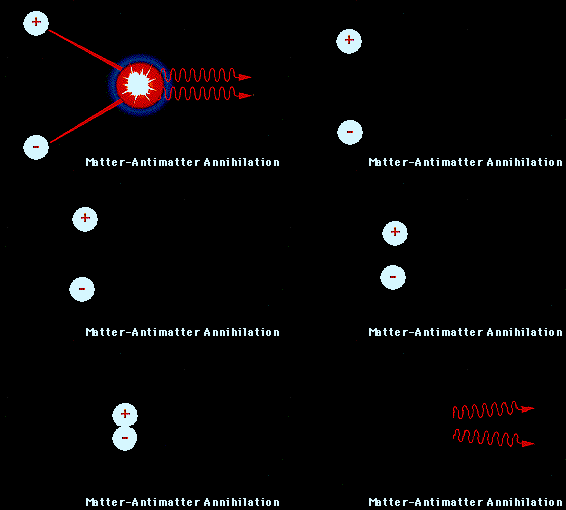
(What is antimatter? Take two particles of identical mass and equal but opposite electrical charge. By convention the rarer type of the mirror-image pair is dubbed the antiparticle. When a fundamental particle, like an electron, meets its antiparticle, a positron, the pair transforms into electromagnetic energy. Proton/antiproton encounters also transform into energy -- but since protons and antiprotons are not fundamental particles [they're composed of quarks and antiquarks, which are], the transformation is a multistep process. The bottom line: you can't store antimatter in a regular-matter box.)
Back to the news ... "Ephemeral Antimatter Trapped for Amazingly Long 16 Minutes," reports Livescience.com. What makes this story newsworthy is that the antimatter being stored is atoms of antihydrogen. Positrons and antiprotons are electrically charged; suspending them in a vacuum -- so that they don't encounter any normal matter -- is no different in principle than storing electrons or protons in a vacuum. That is a trick routinely managed in particle accelerators worldwide, using magnets to interact with the particles' electrical charges.
Combine a positron with an antiproton (or an electron with a proton) into a simple atom and the electrical charges offset each other. A storage container for antihydrogen must interact with something other than electrical charge, because the atom, being neutral, doesn't have any overall electrical charge.
Interact with what, then? Tiny spinning electrical charges -- and they don't come tinier than charged subatomic particles -- generate tiny magnetic fields. The two spinning particles that comprise an atom of hydrogen or antihydrogen are slightly separated, and that separation creates a magnetic dipole. The CERN antimatter trap interacts magnetically with the trapped antihydrogen atoms.
Per my previous antimatter post, creating and capturing even a single antimatter particle takes some doing (and beaucoup money). Hence, CERN is dealing with only a few antihydrogen atoms at a time. Less science-y articles -- like this, from a USA Today writer -- alas likened the latest achievement to the Dan Brown book Angels and Demons, a present-day novel that employs antimatter in bomb-equivalent quantities. A wildly exaggerated production level for antimatter is not too egregious as literary license. This is: characters in Brown's novel imbued the antimatter with all manner of theological significance. It was pure (with extreme euphemism) poppycock.
Back to the news ... "Ephemeral Antimatter Trapped for Amazingly Long 16 Minutes," reports Livescience.com. What makes this story newsworthy is that the antimatter being stored is atoms of antihydrogen. Positrons and antiprotons are electrically charged; suspending them in a vacuum -- so that they don't encounter any normal matter -- is no different in principle than storing electrons or protons in a vacuum. That is a trick routinely managed in particle accelerators worldwide, using magnets to interact with the particles' electrical charges.
Combine a positron with an antiproton (or an electron with a proton) into a simple atom and the electrical charges offset each other. A storage container for antihydrogen must interact with something other than electrical charge, because the atom, being neutral, doesn't have any overall electrical charge.
Interact with what, then? Tiny spinning electrical charges -- and they don't come tinier than charged subatomic particles -- generate tiny magnetic fields. The two spinning particles that comprise an atom of hydrogen or antihydrogen are slightly separated, and that separation creates a magnetic dipole. The CERN antimatter trap interacts magnetically with the trapped antihydrogen atoms.
Per my previous antimatter post, creating and capturing even a single antimatter particle takes some doing (and beaucoup money). Hence, CERN is dealing with only a few antihydrogen atoms at a time. Less science-y articles -- like this, from a USA Today writer -- alas likened the latest achievement to the Dan Brown book Angels and Demons, a present-day novel that employs antimatter in bomb-equivalent quantities. A wildly exaggerated production level for antimatter is not too egregious as literary license. This is: characters in Brown's novel imbued the antimatter with all manner of theological significance. It was pure (with extreme euphemism) poppycock.
Subscribe to:
Posts (Atom)