Tuesday, November 20, 2012

Move along, folks ...

Nothing to see here. Not this week. Nothing new, in any case. (But don't be shy. Check out the vintage stuff.)

Why this non-post? Life and deadlines intrude. Nothing bad, just stuff -- and stuffing -- that needs my attention. Yesterday, most of it.

Next week, after I'm recovered from the tryptophan coma (cue Ah-nold) ... I'll be back.

Happy Turkey Day!

Tuesday, November 13, 2012

Time out(s)

I've opined on this blog that time travel is a science-fictional trope -- but that doesn't mean I disapprove. Tropes endure in literature (and not only in SF) because they support great storytelling. And so, on occasion, I indulge ...

If you visit here from an interest in my SF writing -- or if you're curious about it -- I thought I'd mention my new time-travel novella. (A few years ago I did a time-travel novel: Countdown to Armageddon.  Before that, my time-travel short story "Grandpa?" became the award-winning short film "The Grandfather Paradox.")

Anyway ... "Time Out" will appear in the January/February issue of Analog Science Fiction and Fact.

(Or is appearing. Apropos of time travel, we Analog subscribers already have this issue in hand or e-reader. The cover date is the latest you might expect to encounter the print edition at a bookstore. To further muddle the timeline, in e-book outlets the issue will linger for months after the cover date.)

Tuesday, November 6, 2012

While we wait ...

A very consequential election. The ongoing Superstorm Sandy mess/clean-up in the Northeast (with a nor'easter en route). Though today is my weekly day to post, my mind isn't on blogging -- and I believe that's understandable.

Sharing thought-provoking (or offbeat) science, technology, and SF items from my grab bag won't demand much concentration on my part (kinda essential today) and they may divert you.

Remember last year's tsunami in Japan? It caused shutdowns at, and radiation releases (but, to date, no radiation-related deaths) from, the four Fukushima nuclear power plants. It led several countries to move toward the complete elimination of nuclear power from their national grids. Remember the hyperventilating concern about US nukes in the event of natural disaster?

Almost lost in the coverage of Sandy's impacts is this: "Problems at Five Nuke Plants." What sort of problems? Amid countless storm-related grid disturbances, these nuclear plants responded as designed. One of the five "problems" was a plant dialing down its output to 91 percent of capacity. That seems (IMO) pretty tame compared to "ConEd Explosion During Hurricane Sandy Rocks Manhattan's Lower East Side" and "Outages, floods hit two New Jersey refineries; others restart." Nukes are a robust part of the national energy system. I'd like to see more of them.

Monday, October 29, 2012

As I was saying ...


Several weeks ago I recorded two interviews, one on radio and a second on TV. Both interviews are now streamable.

On the radio program Cover to Cover Book Beat, Larry Niven and I discuss Fate of Worlds (and, to some degree, the entire Fleet of Worlds series).

On cable TV, Fast Forward: Contemporary Science Fiction interviewed me about both Energized and Fate of Worlds.


Although I usually post on Tuesdays, I'm posting this today lest I have a Frankenstorm blackout or comm outage. Wish me luck.

Tuesday, October 23, 2012

Of cyber stalking and cyberwar

Let's begin with the snitch in our pockets. Consider that:
There was an interesting op-ed piece in the New York Times ... that argued that we should begin calling our cell phones by a more accurate descriptive name, e.g., our personal “tracker.” The piece argues that the purpose of cell phones is increasingly less about servicing the communication needs of their owners, and increasing more about gathering data about their users’ activities to be analyzed by third parties, commercial and government alike.
Did you find the NYT article linked to in that snippet a tad discouraging? Me, too. For more of the IEEE Spectrum opinion piece from which that paragraph was excerpted see "Is Your Cell Phone Snitching on You?".

Stuxnet, per DOE
On a more global scale, consider the Stuxnet and Flame worms set loose to disrupt the Iranian nuclear program (and mind you, I think the goal is beyond admirable).

Tuesday, October 16, 2012

Taking the long view

Security lapses long predate computers. Your list of favorite breaches may differ, but DeVry University nonetheless came up with an interesting set (seemingly in the belief history began around 1600). See "Top Information Security Breaches in History."

Meanwhile, the slow, painful, embarrassing celebration of America's retreat from manned spaceflight continues with one shuttle's hours-per mile crawl through urban streets. Maneuvering past the pine trees ... how's that for space-age ambition? See "Endeavour takes 12-mile trek through the streets of Los Angeles."

But wait! There's more ...

Tuesday, October 9, 2012

Food, fuel, and funds for thought

Asteroids can be valuable, even when you're smacked by one. See (from Yahoo News): "Russian asteroid crater revealed to be filled with over $1 quadrillion of diamonds." That's a lot, even by Washington standards :-)

These are "impact diamonds," forged in the shock and pressure of the asteroid striking. Not every form of carbon is as valued as diamond. Here's a thoughtful piece asking whether the US trend away from the use of coal matters as China uses more and more. See (from the WSJ) "Coal Comfort."

Coal produces a lot of electricity -- and a lot of electricity goes to computing. Do you (or does your employer) use a rented computer? Then consider (from the LA Times) that, "Software let rent-to-own companies spy on customers." With: keystroke logging. Screenshot capture. Peeking through webcams.

How could that happen? Some rental companies use add-on software called Detective Mode, ostensibly to keep track of the location of their computers. But that's not all the software has been used for ...

Tuesday, October 2, 2012

Oddities of the day

My file of assorted science-and-tech news is once again bulging. A smattering:

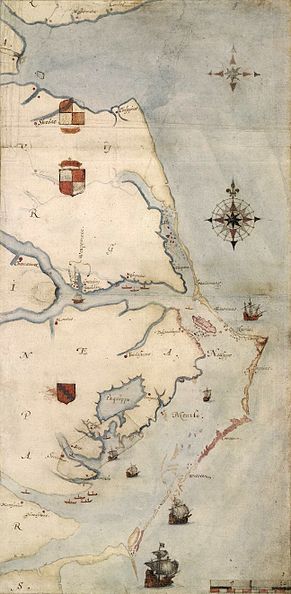
1585 map
Archeology isn't a science that I often touch upon in this blog, but that's not for any lack of personal interest. I'll start today with a mystery that has fascinated me since I was a boy (in not quite Colonial times): the Lost Colony. Maybe it's no longer quite so lost. See "New clue to mystery of lost Roanoke colony."

The short version: "A patch on White's 425-year-old "Virginea Pars" map may indicate where the colony went."

Next up: a contrarian view of Google (host, as it happens, of this blog). "Peter Thiel Says Google’s Not Really a Tech Company." No stranger to technology companies, Thiel (a cofounder of Paypal) argues that: