Tuesday, August 31, 2010

Privacy? We don't need no stinkin' privacy

The tug of war continues between privacy and network-enabled conveniences.  To support that thesis, herewith some clippings from my comment-sometime-on-this-stuff file.

Your cell phone (unless it's a many-years-old relic) reveals your location. That is: most cells contain GPS locators or accomplish the slightly less accurate equivalent by triangulating your position from nearby cell-phone towers. So, naturally, many online services want to track you. Think the only downside is too many discounts sent to your cell as you walk by stores? Read this PC World essay by security consultant Dan Tynan.

Love your smartphone? No doubt, but how secure is the data you store on it? Sure, there's sensitive data on your PC, too -- but it, hopefully, is behind a firewall. Mobileburn reports a major breach in the security of the new, popular Android OS for cell phones. So how sure are you about storing your credit-card info on your cell for shopping convenience?

My stories "The Day of the RFIDs" and "The Night of the RFIDs" looked ahead to the privacy risks inherent in smart wireless tags in, for example, clothing. (Ditto my nonfiction article, "Beyond This Point be RFIDs.") Far fetched? Actually, the future is here.  Last month Wal-Mart announced its plans to put RFID tags in individual garments.
One reason to worry about someone reading RFID tags is that neither privacy-centric public policy (should one ever emerge) nor the good intentions of data collectors assures data will be used only appropriately -- even assuming we could agree on uses that are appropriate. How secure are big data repositories? The National Security Agency's 'Perfect Citizen' program primarily worries about mayhem made possible by networked access to infrastructure (as did, in part, my 2008 novel Fools' Experiments), but it also begs the question of organized crime finding some data repositories too tempting to leave alone.

Yet to come on any large scale -- but eminently doable -- is RFID chips implanted in people. Some pets are already chipped, allowing them to be IDed if they roam. Chipping people offers some real advantages, such as a repository for medical records instantly available for patients who are unable to speak for, even to identify, themselves. But how secure will the data be on your chip? And will the chips all of us may someday carry become vectors for spreading malware to computers? The latter has already been done, at least as a stunt.

"Privacy is dead," we were told by Bill Joy, the Chief Technical Officer of (defunct) Sun Microsystems. Now Mark Zuckerberg, CEO of Facebook tells us the same thing. Having helped to kill it, so he should know.

We live in interesting times ...

Monday, August 23, 2010

Wanted: quantum scientist

We have quantum mechanics -- lots of them -- and they are extremely good at what they do. A bazillion transistors, lasers, and solar cells leave no room for doubt.

(Warning: I haven't cluttered this post with links, because practically every phrase in it could be a link to an article defining some esoterica. Wikipedia is your friend. The eye-crossing graphic nearby is from the double-slit-experiment article at Wikipedia.)  

And Roman engineers built extremely good roads, bridges, and aqueducts without any clue about material science.

Tuesday, August 17, 2010

Deconstruction

I spent the weekend before last (i.e., August 5-8) in Raleigh, NC at ReConStruction / NASFiC (aka the Tenth Occasional North American Science Fiction Convention). NASFiCs are held in the years, like this year, that Worldcon is outside North America.

The con had a lot to offer, and I thank the organizers for their hard work and for including me in the program. I took part in four panels, did an autograph session (and thanks to all of you who came), and held a kaffee klatch. I synched up with friends usually scattered around the country, especially from among the MAFIA. (Acronym.com does not yet know it, but that's writers  Making Appearances Frequently In Analog.) I saw a bit of downtown Raleigh, which seems quite nice. All good fun. 

And yet ...

Tuesday, August 10, 2010

Clawing one's way to literary success

Today's post will be something of a change.

I met Stacey Cochran last summer at Launch Pad, the NASA-funded astronomy program for writers. Stacey has been charting his own course, through self-publishing and ebooks. It's an interesting story -- and the stories Stacey has to tell are interesting, too -- so I invited him to SF and Nonsense to explain.

Without further ado, heeeeeere's Stacey.

Tuesday, August 3, 2010

Real nanotech. Real medicine. And zombies.

Small Miracles is my near-future medical nanotechnology thriller -- and as of today, it's been reissued in mass-market paperback.

For the paperback edition, the cover background has been made lighter and brighter. That's a welcome change: you no longer have to take my word for it that those nanobots are swimming in blood :-)

Curious? Here's my October 2009 announcement of the hardback edition. For a sample from the novel, click through to Amazon. And here are a few recent reviews: 

Tuesday, July 27, 2010

Keeping track of progress

Golden Age SF promised us a future that still eludes us.

Cheap and limitless power from fusion? Hah! True AIs, the kind that can be your Internet avatar or operate a multi-purpose home robot? Hah! Hah! Space colonization? Yeah, right. Space tourism, only if you're a millionaire. Commercial air travel is no faster than in the Sixties (and actually much slower end to end, when adjusted for TSA delays and ATC congestion). People have built flying cars, but they're (IMO) silly curiosities, poor choices as either a plane or a car.

Of course SF mostly missed computing and computers. We do have a wondrous Internet, smartphones, and personal computers that run rings around the mainframes on which I learned to program.

Still: even the Internet/smartphones/PCs sometimes disappoint. How much Internet capacity supports pointless drivel? (I'm thinking: 500 *million* people on Facebook. Umm, why? Plenty o' porn. 99% of what's on YouTube. And don't get me started on Twitter.) And how many smartphone apps are totally trivial?

Although I buy a new PC every few years, always vastly more powerful than the last, it's hardly because of progress. Invariably the old computer can still process words, calculate spreadsheets, browse the web, and email to my satisfaction. No, the reasons to buy a new computer are (a) because the old bloated, unreliable, nonsecure OS will no longer be supported, so that Microsoft can make me buy a new bloated, unreliable, nonsecure OS and (b) to run a new generation of security software against the @#$%! who write malware.

And yet there *is* progress. Witness: the Global Positioning System. For not much over a hundred bucks (although you can certainly spend more, for more features), you can own a GPS receiver to locate yourself precisely anywhere in the world and plan your route to most anywhere else. For sure, the Golden Age prognosticators entirely missed that possibility.

Thursday, July 22, 2010

Curiouser and curiouser

Like many SF aficionados, I enjoy time-travel stories. I've written them myself, most recently in Countdown to Armageddon.  So I enjoyed a recent article (although I was disappointed by its lack of detail) claiming that Physicists Tame Time Travel by Forbidding You to Kill Your Grandfather. As for the notion that time protects itself -- and grandparents -- by diddling with  probabilities -- I used that in "Grandpa?" in 2001.

You gotta love a particle so elusive that it passes through the Earth with effectively a zero probability of interacting with ... anything. A particle that may represent a fraction of the universe's mysterious dark matter -- and if it does, will raise questions about the long-lived, heretofore very successful Standard Model of particle physics. A particle that spontaneously cycles between various forms. That particle (more precisely, a class of particles), is, of course, the neutrino

Neutrino astronomers have studied solar neutrinos for years -- and now they're starting to look at Earth's own neutrinos. Since neutrinos are produced in nuclear decays, radioactive elements in the Earth's core are neutrino sources -- and a way to study Earth's deep interior. Details at Physicists hunt for a trace of the elusive, invisible geoneutrino.

Friday, July 16, 2010

Sounding off

Last updated April 1, 2025

I'm asked almost as often about the availability of my books in audio formats as about ebooks. So: I've decided to maintain a running list of my titles to which you can listen.

(Because what the heck -- high-tech mayhem, exotic aliens, monomaniacal AIs, and such are sure to enhance any road trip.)

Availability in any audio format often implies a variety of listening options: CDs, tapes (I'm not making this stuff up!), MP3, and other downloads. The links that follow give more information about a particular title. If you click through from my descriptive page to the corresponding Amazon page (or get to a title by way of Ed's Bookstore), the "formats" list, generally near and to the right of the book cover, will list your audio (and other) format options. 

Lerner solos currently in audio format

Probe (1991 [2011 and 2020 reissues])
Moonstruck (2005 [2011 and 2020 reissues])
Small Miracles (2009 [2015 reissue])
InterstellarNet: Origins (2010)
InterstellarNet: New Order (2010)
Energized (2012 [2018 reissue])
Déjà Doomed (2021)  
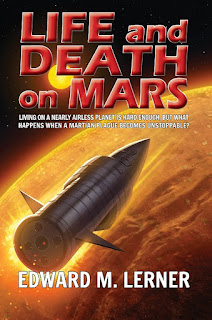
Life and Death on Mars (2023)


Lerner collaborations in audio format

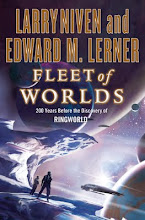
Fleet of Worlds (2007)
Juggler of Worlds (2008)
Destroyer of Worlds (2009)
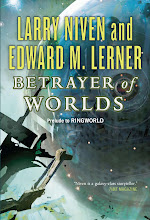
Betrayer of Worlds (2010)
Fate of Worlds (2012)