Tuesday, May 27, 2014

Hoist on my own prolificness :-)

At about this time last year, I was pleased to post (Faster than a speeding photon) about the recently awarded Analog Readers Poll awards, aka the Analytical Laboratory awards, aka the Anlabs.

Down the rabbit (er, worm) hole
Why pleased? Because my 2012 article ("Faster than a speeding photon: The Why, Where, and (Perhaps the) How of Faster-Than-Light Technology" had won in the science-fact category. After decades as a regular Analog reader and years as a regular contributor, the honor meant a lot to me. The year previous (i.e., two years ago), I'd tied with myself for second place in that same Anlabs category.

And this year's Anlabs?

Tuesday, May 20, 2014

Arcana and SFundry

Remember the Atari game console? How about the ET game that is widely credited with killing off said console? Well ...

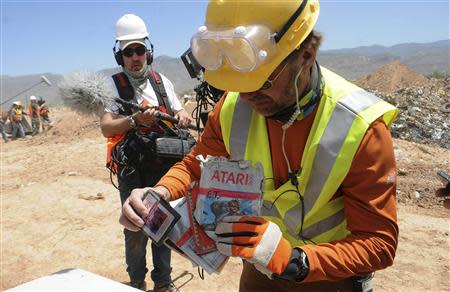
Documentary filmmakers digging in a New Mexico landfill on Saturday unearthed hundreds of "E.T. the Extra-Terrestrial" cartridges, considered by some the worst video game ever made and blamed for contributing to the downfall of the video game industry in the 1980s. ...

Atari is believed to have been saddled with most of the 5 million E.T. game cartridges produced. According to New York Times reports at the time, the game manufacturer buried the games in the New Mexico desert in the middle of the night.

Note hazmat gear :-)
See -- if you dare -- "Atari cartridges found in New Mexico landfill." Or, for the Onion's always amusing take, see, " ‘E.T.’ Video Game Cartridges Unearthed In New Mexico Landfill."

But wait! There's more!

Tuesday, May 13, 2014

Follow up ... the sequel

Last week (Follow (and foul) up), I took a second (or third, or maybe fourth) look at some hot issues of the day: Internet governance. American dependence on an increasingly aggressive Russia for civilian spaceflight -- and even launchers for military missions. The XPocalypse.

Today's post, although continuing a follow-up theme, is less connected with the mainstream news -- if no less consequential.

They're everywhere ...
In February, as part of "That does not compute," I wrote about the Internet of Things (IoT). Often, I write about hacking and computer-security issues. Just so you know: it's not only me concerned about the confluence of IoT and (in)security. A couple of choice quotes from Information Week's recent article, "Internet of Thingbots: The New Security Worry."
The IoT consisted of 20 billion devices in 2013 and will have 32 billion by 2020, according to the research firm IDC. The boom in IoT-enabled gadgets and sensors is a boon for hackers, whose device-focused attacks are starting to make headlines.
and
The race to push connected devices out the door isn't helping, either. "The big problem we're seeing these days is, in so many cases, people are rushing to get products out, and they're not putting the time and effort into really securing these devices up front," Morrison said. "It's not like we don't know how to do it; it's just that we're not doing it."
And many will be mobile
"Thingbots?" you ask. They may be closer than you think -- and not only Roombas scooting about to vacuum your floors (and terrorize your pets). Here's a video (courtesy of IEEE Spectrum) to make the case: "Watch SRI's Nimble Microrobots Cooperate to Build Structures." As in: 
 ... swarms of magnetically actuated microrobots that can work together to build macro-scale structures.
Not the kind of creatures you would want hacked.

(Not yet sold that the IoT is nigh? Internet-equipment giant Cisco is convinced -- and they're putting up real money to prove it. See "Cisco Drops $150M In Investment Funding For Internet Of Things Startups.")

Tuesday, May 6, 2014

Follow (and foul) up

Today I'm going to revisit a few newsworthy events that have drawn my attention (and, on occasion, my ire). Because all is not well ...

The modern world
A mere four weeks ago, on April 8, the post "Wild and crazy (not always in a good way) stuff," included my latest distress about plans to relinquish American governance of the Internet. (For earlier facets of the Internet governance issue, from December 2012, see "The UN? Seriously?" and "Big Brother redux.")

Perhaps that unilateral abdication to repressive, censoring regimes won't happen, at least not yet. See, "Reversal: Obama may not surrender control of the Internet after all." Nonetheless, authoritarian encroachment into the onetime uncensored and global 'net grows apace. It's not only the Great Firewall of China. See, for example, from a week ago, "Google Warning on Russia Prescient as Putin Squeezes Web."

Tuesday, April 29, 2014

Where do you get your (crazy) ideas?

(A post especially for aspiring spec-fic writers.)

"Where do you get your (crazy) ideas?" It's the question that authors -- especially SF authors -- all dread. There is simply no short but useful answer. Our first course of action is to (try to) deflect the questioner with humor.

In 2011, I took a look at the topic in Inspiration. But after a serendipitous sighting (image nearby), the time seemed ripe for a revisit ...

This isn't my photo -- I spotted this road sign (on Virginia Route 28, just north of Dulles airport) while zipping past at about shh!/no-comment mph. But I felt confident that the web would provide. And sure enough ...

(An SF story practically writes itself.)

I probably don't want to know how SPNW85 did take this photo. Regardless, I'm glad s/he did. What SF author wouldn't?

Tuesday, April 22, 2014

Cyber grief

!@%$##! Heartbleed bug! If -- somehow -- that term doesn't ring a bell, see "How to Protect Yourself From the Heartbleed Bug." Right now. Really, I'm not kidding. But do come back. 

(For a more technical look at the problem, see The Heartbleed Bug.)

Sigh ...
The Heartbleed-centric hit to productivity -- certainly to mine -- is staggering. On how many websites does each of us have an account that suddenly needs a new password? While you tally those up, don't forget every long dormant etail account in which you ever paid with a credit card, or with which you may have used a password you're still using elsewhere. Sigh.

It's the kind of thing that makes one wonder about using a virtual currency -- if the recent travails of bitcoin haven't already convinced you.

Unfamiliar with virtual currencies like bitcoin? Very briefly, a virtual currency is a digital asset class (a) created, maintained, exchanged, and stored by private parties outside the normal banking system (b) independent of government monetary authorities. 

A unit of virtual currency can be exchanged for conventional currency. Virtual currency can also be used directly (at only a few businesses, so far) to acquire goods and services. The most popular virtual currency is bitcoin, units of which are created by solving math problems. Virtual currencies exist only on computers, and so are subject to a variety of security risks -- as in, "Bitcoin and other cryptocurrencies compromised by Pony botnet."

Tuesday, April 15, 2014

Going postal. Or: The stats, stat.

About three years ago I first compiled a list/overview of what were then the most visited posts here at SF and Nonsense. To my surprise, Postscript (or is that post post?) was itself instantly popular. It remains third on the all-time list.

And so, an annual tradition was born. 

Serious posts :-)
From a stats snapshot I captured a few days ago (thanks, Blogger!), here's the complete all-time top-ten list.

Of moons, clouds, and the state of the art(s), a general science-and-tech news post from August 2013, shot straight to the top of the list. I found these items interesting -- but no more so than news I've highlighted in many other posts. I offer no theories why this specific post is so popular.

(If any readers care to offer an opinion, that'd be keen.)

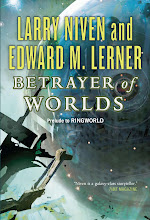
Number two, slipped from the lead position last year, is Betrayer of Worlds, the October 2010 announcement of a novel's original release. This novel being fourth in a five-part series, the persistent popularity of its post is also something of a puzzler.

Number three, as already noted, is Postscript (or is that post post?), the original posting stats.

Tuesday, April 8, 2014

Wild and crazy (not always in a good way) stuff

It will surprise no one who often stops by this blog that I follow science news -- but that doesn't mean I get excited about every supposed finding. Perhaps that's because some reported results are made up. See, from Scientific American, "Publishers Withdraw More than 120 Gibberish Science and Engineering Papers." Because said papers were shown to be computer-generated nonsense!

Bigger than worlds
It should likewise be no surprise that I follow reports about hacking -- but this headline (from the IEEE) blew me away: "Hacking the Van Allen Belts: Could we save satellites and astronauts by wiping out the Van Allen belts?" I'd be loath to tinker with a system as little understood as interactions between Earth and its nearby space, but the possibility is fascinating. And I can see the case for restoring the Belts to their natural state before above-ground nuclear testing.

Because there are a lot of satellites. Don't take my word for it when you can see "Every single satellite orbiting Earth, in a single image."