The Year of Science enters its final month by celebrating health science. (Is health science different than medicine? Beats me.)
Health-wise, science must be doing something right. To know that, we need only look at trends in lifespan and at the once untreatable conditions that medicine can now address. And consider the many quality-of-life improvements, from prostheses to painkillers.
Health science will only get better -- if public policy doesn't kill off R&D in the name of funding universal care.
Below the fold, the shape of things to come:
Tuesday, December 8, 2009
To your good health
Posted by
Edward M. Lerner
at
5:25 PM
Labels:
fools' experiments,
science,
small miracles,
technology,
Year of Science 2009
Tuesday, December 1, 2009
Road trip
I'm off soon on a book signing mini-tour promoting Small Miracles. (I did local signings, in the DC area, in October.)
If you're in the neighborhood, consider dropping by. (I'm happy to sign anything I've written, so check your bookshelves.)
Read on for places and times:
If you're in the neighborhood, consider dropping by. (I'm happy to sign anything I've written, so check your bookshelves.)
Read on for places and times:
Posted by
Edward M. Lerner
at
9:29 AM
Labels:
ed's fiction,
science fiction,
sf,
small miracles,
technothriller
Wednesday, November 25, 2009
Life, the universe, and everything (SFnal)
I knew this interview was pending on the popular book-review site Bookloons, but not exactly when the transcript would appear online. Today, as it happens.
We covered a lot of ground. Among the topics:
Bookloons also posted its review of the recently released Small Miracles, concluding: "I highly recommend Small Miracles to anyone interested in relatively near future SF, and in the fascinating possibilities of nanotechnology."
We covered a lot of ground. Among the topics:
- themes in my recent novels (which the interviewer dubs "near-future, near-apocalyptic thrillers")
- the prospect of societal controls over new technologies
- how SF portrays artificial intelligences
- if/how AI might come to be
- the risks of nanotechnology
Bookloons also posted its review of the recently released Small Miracles, concluding: "I highly recommend Small Miracles to anyone interested in relatively near future SF, and in the fascinating possibilities of nanotechnology."
Posted by
Edward M. Lerner
at
4:15 PM
Labels:
AI,
ed's fiction,
fools' experiments,
InterstellarNet,
interviews,
Larry Niven,
nanotech,
science fiction,
sf,
small miracles,
technothriller
Tuesday, November 24, 2009
Thanksgiving appetizers
Thanksgiving makes for a shortened work week (and yet here you are, surfing), and the turkey et. al. aren't going to eat themselves.
I'm going to post this ahead of The Day, before the blogger (and perhaps a reader or two) succumbs to a tryptophan stupor. So, herewith a few pre-holiday mental appetizers ...
Posted by
Edward M. Lerner
at
11:59 AM
Labels:
current events,
fools' experiments,
lhc,
physics,
science,
sociology,
technology
Thursday, November 19, 2009
Feel the chemistry
November's theme at the Year of Science is chemistry.
Good stuff, chemistry. You won't hear me complaining this month about wishy-washy, politically correct themes. This is science.
(But not, IIRC, the stuff of much SF. I'm hard-pressed to think of a single chemistry-centric SF novel. Can anyone out there suggest some?)
And chemistry is the basis for indispensable technology. Think of DuPont (and countless others) bringing us Better Living through Chemistry. Where would we be -- no irony intended, if you should wonder -- sans (to name a few chemical products) preservatives, plastics, petrochemicals, and pesticides.
I'm inspired to remember long-ago chemistry classes -- where I learned to respect the people who really could ascertain something in the lab. (Ever been given a mystery chemical and a few hours to identify it? I might have been given been a flask of phlogiston dioxide for all I know.) Identifying mystery chemicals takes real skill.
But somehow the YoS people neglected to include Tom Lehrer singing the periodic table. Trust me: it's a hoot. The retconned video only makes it better.
Good stuff, chemistry. You won't hear me complaining this month about wishy-washy, politically correct themes. This is science.(But not, IIRC, the stuff of much SF. I'm hard-pressed to think of a single chemistry-centric SF novel. Can anyone out there suggest some?)
And chemistry is the basis for indispensable technology. Think of DuPont (and countless others) bringing us Better Living through Chemistry. Where would we be -- no irony intended, if you should wonder -- sans (to name a few chemical products) preservatives, plastics, petrochemicals, and pesticides.
I'm inspired to remember long-ago chemistry classes -- where I learned to respect the people who really could ascertain something in the lab. (Ever been given a mystery chemical and a few hours to identify it? I might have been given been a flask of phlogiston dioxide for all I know.) Identifying mystery chemicals takes real skill.
But somehow the YoS people neglected to include Tom Lehrer singing the periodic table. Trust me: it's a hoot. The retconned video only makes it better.
Tuesday, November 10, 2009
Destroyer of Worlds
Fair warning: this is a commercial announcement. (But likely my last for a while. Gotta refill the pipeline.)
Destroyer of Worlds
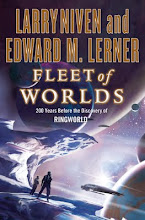
, released today, is a far-future space epic. It's also my latest/third collaboration with Larry Niven -- all part of our Fleet of Worlds series.
Destroyer, like our earlier books, deals with Puppeteer manipulations -- these aliens are aptly named for more than their appearance. And the afraid-of-everything Puppeteers have more than ever to fear, because on the horizon looms another, particularly scary, alien species: the Pak.
(That brings us to our second cover snap [below the fold].
![]() |
| Destroyer of Worlds |
Destroyer, like our earlier books, deals with Puppeteer manipulations -- these aliens are aptly named for more than their appearance. And the afraid-of-everything Puppeteers have more than ever to fear, because on the horizon looms another, particularly scary, alien species: the Pak.
(That brings us to our second cover snap [below the fold].
Posted by
Edward M. Lerner
at
9:55 AM
Labels:
aliens,
destroyer of worlds,
ed's fiction,
fleet of worlds,
Larry Niven,
puppeteer,
science fiction,
sf
Friday, November 6, 2009
Trope-ing the light fantastic (Earths)
That's Earths, plural. Obviously Earth itself exists and can hardly be a trope.
But what about the many Earthlike planets in SF? (How often does the starship Enterprise encounter a solar system without an "M class" planet or moon?) Are Earthlike worlds realistic or a trope?
Our native solar system has but one Earth, of course. Real-life searches for extrasolar planets best spot large, massive, and close-to-their-primary objects. The observational methods are not yet sensitive enough to spot Earthlike planets (see current list of extrasolar planets here). IIRC, the smallest extrasolar planet yet found is about five Earth masses. There may be -- and presumably are -- other Earthlike planets, but searches to date say little yet about the prevalence of such planets.
But what about the many Earthlike planets in SF? (How often does the starship Enterprise encounter a solar system without an "M class" planet or moon?) Are Earthlike worlds realistic or a trope?
Our native solar system has but one Earth, of course. Real-life searches for extrasolar planets best spot large, massive, and close-to-their-primary objects. The observational methods are not yet sensitive enough to spot Earthlike planets (see current list of extrasolar planets here). IIRC, the smallest extrasolar planet yet found is about five Earth masses. There may be -- and presumably are -- other Earthlike planets, but searches to date say little yet about the prevalence of such planets.
Tuesday, November 3, 2009
Future shlock
Today is Election Day in the Commonwealth of Virginia.
Yup, we're one of the two states -- not, you will note, that we call ourselves a state -- with regularly scheduled statewide elections this year. (New Jersey is the second.) In theory that's so state elections go unaffected by national political tides. The Law of Unintended Consequences remaining in force, it really means the national political parties focus on these two states, making the electoral process here (a) a referendum on the national balance of political power and (b) a dry run for methods to be tried in the following year's Congressional elections. And so, national money floods into -- and distorts -- Virginia state races.
The national/state overlap is always bad in Virginia, because we're just across the Potomac from DC. There's not even travel inconvenience to discourage national politicians from meddling. The problem is made worse this cycle by our outgoing governor happening also to be the party chairman for a national party.
Yup, we're one of the two states -- not, you will note, that we call ourselves a state -- with regularly scheduled statewide elections this year. (New Jersey is the second.) In theory that's so state elections go unaffected by national political tides. The Law of Unintended Consequences remaining in force, it really means the national political parties focus on these two states, making the electoral process here (a) a referendum on the national balance of political power and (b) a dry run for methods to be tried in the following year's Congressional elections. And so, national money floods into -- and distorts -- Virginia state races.
The national/state overlap is always bad in Virginia, because we're just across the Potomac from DC. There's not even travel inconvenience to discourage national politicians from meddling. The problem is made worse this cycle by our outgoing governor happening also to be the party chairman for a national party.
Subscribe to:
Posts (Atom)