Tuesday, June 7, 2011

Antimatter matters ... the hole truth(?)

Follow-up to my January post Antimatter matters ... the talented folks at CERN, who previously brought us the Large Hardon Collider, have learned to store antimatter effectively indefinitely.

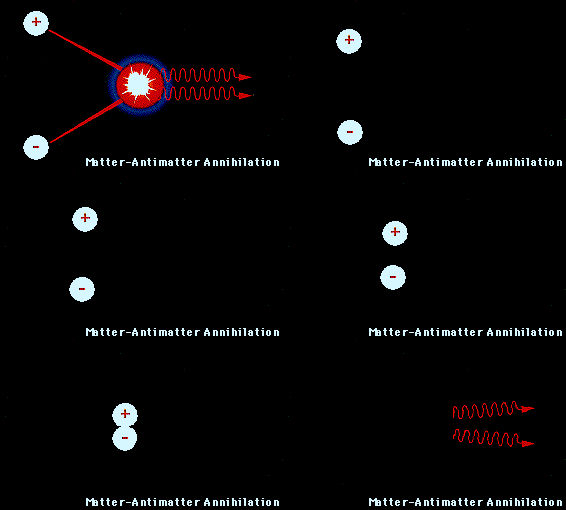
(What is antimatter? Take two particles of identical mass and equal but opposite electrical charge. By convention the rarer type of the mirror-image pair is dubbed the antiparticle. When a fundamental particle, like an electron, meets its antiparticle, a positron, the pair transforms into electromagnetic energy. Proton/antiproton encounters also transform into energy -- but since protons and antiprotons are not fundamental particles [they're composed of quarks and antiquarks, which are], the transformation is a multistep process. The bottom line: you can't store antimatter in a regular-matter box.)

Back to the news ... "Ephemeral Antimatter Trapped for Amazingly Long 16 Minutes," reports Livescience.com. What makes this story newsworthy is that the antimatter being stored is atoms of antihydrogen. Positrons and antiprotons are electrically charged; suspending them in a vacuum -- so that they don't encounter any normal matter -- is no different in principle than storing electrons or protons in a vacuum. That is a trick routinely managed in particle accelerators worldwide, using magnets to interact with the particles' electrical charges.

Combine a positron with an antiproton (or an electron with a proton) into a simple atom and the electrical charges offset each other. A storage container for antihydrogen must interact with something other than electrical charge, because the atom, being neutral, doesn't have any overall electrical charge.

Interact with what, then? Tiny spinning electrical charges -- and they don't come tinier than charged subatomic particles -- generate tiny magnetic fields. The two spinning particles that comprise an atom of hydrogen or antihydrogen are slightly separated, and that separation creates a magnetic dipole. The CERN antimatter trap interacts magnetically with the trapped antihydrogen atoms.

Per my previous antimatter post, creating and capturing even a single antimatter particle takes some doing (and beaucoup money). Hence, CERN is dealing with only a few antihydrogen atoms at a time. Less science-y articles -- like this, from a USA Today writer -- alas likened the latest achievement to the Dan Brown book Angels and Demons, a present-day novel that employs antimatter in bomb-equivalent quantities.  A wildly exaggerated production level for antimatter is not too egregious as literary license. This is: characters in Brown's novel imbued the antimatter with all manner of theological significance. It was pure (with extreme euphemism) poppycock.

Monday, May 30, 2011

Crocodile cheers

I've progressed from bemused to troubled to angry at the spate of breathless headlines heralding some "final" activity of a space shuttle. A typical example: "Shuttle Endeavour gone forever from space station." The launch, docking, undocking, and landing of each shuttle in the fleet is getting this kind of  treatment. Oh, and the dispersal of the shuttles to museums draws press attention, too.

Why am I so cranky? Because endings are pretty much the only aspect of the U.S. manned space program to get much media interest. What doesn't draw much media attention?

Tuesday, May 24, 2011

MOONSTRUCK and PROBEd; ENERGIZED, and now BETRAYed

I've had an interesting few months.  My out-of-print first two novels, Probe and Moonstruck, returned to print. My latest novel, Energized, began running as a serial in Analog (look for Energized in book format next year). And the fun continues ...

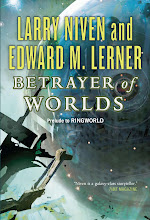
Today sees Betrayer of Worlds re-released in mass-market paperback format.  (It's been available in hardback, ebook, and audio formats). Here's what I had to say when BOW was first released.


Of Betrayer's post-publication reviews, here's my favorite:

Wednesday, May 18, 2011

Buzz (and buzz kill)

Need a jump start some mornings? I know I do.

As Prof. Farnsworth oft said on Futurama: "Good news, everyone." There's no longer any reason to wait till after showering for a caffeine fix. Not when you can (or so the manufacturer claims) get caffeine from your soap. (Really. I'm not making this up, whether or not the Shower Shock people are.)

And you'll want to be awake before you leave home, because there's a new threat to our networked world: GPS jamming. The notion of inexpensive jammers messing with my GPS ... that's very upsetting. As is the possibility (see the same article) that 4G LTE mobile broadband services will interfere with GPS on a wide scale.

Tuesday, May 10, 2011

Caught in our own web

As a writer, I consider hacking and awkwardly timed system crashes grossly overdone as plot devices. As a netizen, I find both all too common. (For a recent discussion, see "It's a mad, mad, interconnected, discombobulated world.")

And wherever one looks, there is another (or a continuing) problem:

Friday, May 6, 2011

Alien probe (no, not that kind)

Twenty years ... yowza. That's how long it's been since Probe, my debut novel, first saw print.

Sadly, Probe has also been long out of print.

So: I am pleased to say that Probe is once more available (with new foreword and afterword), this time in a classy trade paperback edition and -- something scarcely imaginable in 1991 -- as an ebook. The nearby cover is from the new edition.

What is the probe of the title? The hero's own Prospector spacecraft, prowling the Asteroid Belt for mineral wealth? The alien derelict that Prospector had the (mis)fortune to come upon? Something the military does not want found? Or is it something really out of the ordinary?

Tuesday, May 3, 2011

Still crazy after all these (13.5 billion or so) years

The universe is a strange and wondrous place.  (Is it the only place? Not according to multiverse theory. Consider that topic grist for some future post.)

Just in this universe, moving progressively farther from home, we see:

Monday, April 25, 2011

It's a mad, mad, interconnected, discombobulated world

Early this year I posted about cloud computing. (This has been one of my most popular posts and was syndicated by the Netherlands edition of Computerworld.) The moral of that post was: no one watches out for your data like you (should).

Cloud computing, also known as "software as a service" envisions that most people and most organizations will outsource the provisioning and maintenance of computer hardware and software to specialists. You don't generate your own electricity, the argument runs, so why would you want to run your own computer center?

Never mind that with solar panels and windmill generators, a still small but growing community is moving toward providing their own electrical power. Including big IT shops like cloud-app provider Google.

Having mastered the running of very large data centers and handling very large user communities, Amazon entered into cloud computing as a "side" business. It generates a mere half billion or so this way in annual revenues.